Apostrophes
Apostrophes [ ’ ] are pretty simple to use. We’ll go over the three uses and why it’s important to use the apostrophe.
Plurals
In regards to plurals, apostrophes aren’t used that often. You may need to use them for plurals of abbreviated words or to show single letters or numbers in plural form.
Collectively, my husband and I have two PhD’s and three BA’s.
The name, Mississippi, is often misspelled with only three s’s instead of four.
We had a total of $22 dollars. The bills consisted of three 1’s, two 2’s, a 5, and a 10.
My mother and father were born in the early ‘50s.
As stated before, these examples aren’t used that often in formal writing by may be seen more in informal writing or creative writing.
Contractions
Contractions are the combination of two or more words to form one. They are considered informal and shouldn’t be used in academic or professional writing. From what I’ve experienced outside of formal writing and speech, the lack of contraction use comes frequently when a person wishes to place emphasis on one of the words that would make up a contracted word.
I will
not
go to the store today. This emphasizes that the subject won’t go to the store.
I won’t go to the store
today.
Here, they won’t go today, but may go another day.
I will not go to the store
today
. This has the same emphasis as the sentence above, but the flow of the sentence seems a bit off.
Another great example is one of the more popular quotes from
Ace Ventura: Pet Detective
, featuring Jim Carrey. During the scene, Carrey is at a ritzy party and pretends he has to use the restroom. He ends up snooping around and gets into a tussle with a shark. When he returns to the party, he’s soaking wet with tattered clothing. Everyone at the party stops and looks at him as he fans his backside and exclaims, “Do
not
go in there!” It was a clear warning to those at the party that he had created an unpleasant environment in the bathroom. If the line had been written differently, the impact and meaning would have changed. “
Don’t
go in there!” sounds more like a command rather than a warning and would have fallen short in delivery, despite Jim Carrey’s comical acting abilities. The absence of a contraction here made the phrase sound better. In case you’re interested in the scene itself, I’ve included a YouTube link in the “Resources” section of the guide.
Other than emphasis and meaning, contractions can make your writing sound less like a robot and more like a human. Constantly reading non-contracted words can get tiring and may give your work a rudimentary feel. On the contrary, if you’re writing a children’s book, you might want to stick to non-contracted words depending on the age group. A prime example of this would be Dr. Seuss’
Green Eggs and Ham
.
We’ll examine the different forms of the verbs to be and to have.
To Be To Have
I am = I’m I have = I’ve
You are = You’re You have = You’ve
We are = We’re We have = We’ve
They are = They’re They have = They’ve
He, She, It is = He’s, She’s, It’s He, She, It has = He’s, She’s, It’s
A few phrases that contain the word “of” have slightly different contractions than the ones listed above.
Jack-of-the-lantern = Jack-o’-lantern
Will-of-the-Wisp = Will-o’-Wisp
Of the clock = o’clock
Cat-of-nine-tails = Cat-o’-nine-tails
This next part gets a bit tricky as there are multiple ways to write these contractions and quite honestly, some are silly and difficult to say. You’ll easily be able to tell which are non-standard when writing, but often
heard
when speaking.
I would have - I’d have - I would’ve - I’d’ve
I would not have - I wouldn’t have - I’d have not - I wouldn’t’ve
In English, we don’t write things like, “I’d’ve gone to the movies if it didn’t rain.” It’s convenient, but it looks awkward. However, with many languages, words often get smashed together, combined, or shortened regardless of how the proper sentence is written. When spoken quickly, "I would have gone" sounds similar to "I woulda gone" and this causes people to mistake “would have” for “would of”, which is incorrect. The same issue applies to “should have” and “could have” when contracting them to “should’ve” and “could’ve” respectively. Additionally, “who’s”, the contracted form of “who is” gets mistaken for “whose”, the possessive form of who. We’ll get to possessive forms in a moment.
Possessives
Possessives can be pretty simple and can enhance your writing as well. There is no need to constantly write in long-winded sentences when we can get straight to the point. We add an apostrophe plus the letter “s” to possessive noun(s) to show its ownership or relationship to another noun.
The dog that belongs to Pablo is eating a snack. = Pablo’s dog is eating a snack.
The grandmother of Frank doesn’t have teeth. = Frank’s grandmother doesn’t have teeth.
There are a few options to utilize when the possessive noun already ends in “s.”
Tess’s car is on fire. = Tess’ car is on fire.
James’ job called to fire him today. James’s job called to fire him today.
However, plural possessive nouns have to be considered case by case.
The horses’ reins are too tight.
The animals’ cages at the zoo are too small.
The children’s teacher is sick today.
The mice’s whiskers wiggled when their owner gave them cheese.
If there are two possessive nouns and they both have possession over the same item, then we would put the apostrophe plus the letter “s” at the end of the second possessive noun only.
The skipper and his crew’s boat sank into the ocean.
Mom and dad’s bed is comfortable.
Cow and Chicken’s cousin’s name was Boneless.
Similarly, if there are two possessive nouns and they each have possession over the different items, then we would put the apostrophe plus the letter “s” at the end of both nouns.
My cat’s and dog’s beds are both in the den.
Our mom’s and dad’s cars are green and orange.
Jack’s house was not as gloomy as Sally’s.
Also, there are possessive adjectives and pronouns and they function a bit differently.
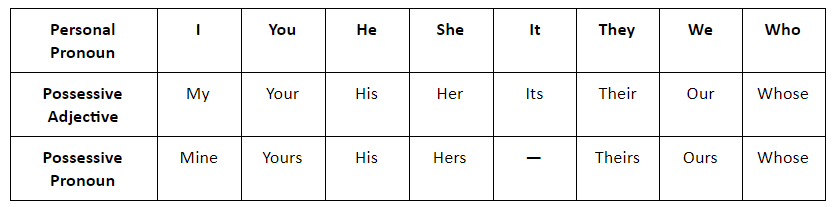
I have cookies. These cookies are mine. These are my cookies
You have a black car. Your car is black. The black car is yours.
Who does this tie belong to? Whose tie is this?
There is a morgue in the house. The house has its own morgue.
Is this their money? Is this money theirs?
If you’re having trouble with these, try writing your own practice sentences in long form. Once you’ve completed that, circle the word that you think should be a possessive noun, pronoun, or adjective, and then rewrite the sentence with the appropriately matching possessive form of the circled word.