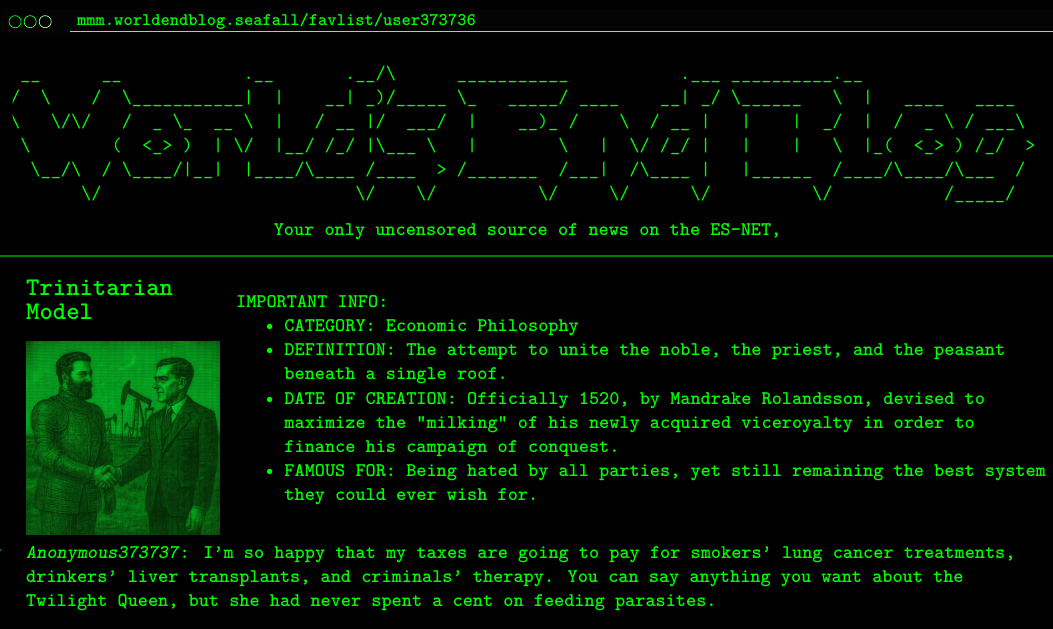
If you can fight, use your leverage to force the enemy into an agreement instead of wasting precious resources.
If you cannot fight, position your troops in the hardest battleground possible, and as the enemy prepares to besiege your position, you can prepare to escape.
If you cannot defend, terrify your troops with stories of their grim fate as prisoners of war to ignite the momentum for a breakthrough in the enemy lines, saving your elite forces forward while sacrificing the dead weight to slow the enemy’s pursuit.
If you cannot flee, find any leverage in your dire situation that might please your enemy because anything is more useful than a dead man.
If you cannot surrender, you should never have reached that point in the first place. Hence, your plan has worked, so there is only one thing left for you to do—write your name in history.
The ’Man’ explains his philosophy of war to his wife.
Romance of the Three Chrysanthemums, Sasara Von Sternenstaub, 1537-1600.
*Screeeeeech!* The rough sound of chalk scraping across the Hybroboard oddly juxtaposed with the soft patter of rain outside, an omen that reminded the dozens of students in the seventh-floor classroom of the Miraval Educational Building that autumn was exhaling its last breath.
”Another year, and another story begins.” The professor, standing below three rows of students, looked up at them with eyes filled with nostalgia as he sipped tea from a hot cup. ”Welcome, my dear students. I am S-Class ’Fortunate Son’ Xoán Al Córdoba, and together, thrice a week, we are going to dissect and study the beating heart of any civilization—the Economy.” A few bored students offered polite applause, while the vast majority clapped, their eyes filled with admiration and enthusiasm for the now-blushing Mr. Al Córdoba.
As the temperature outside demanded, he dressed in warm clothes, though they lacked any animal skin at all. Instead, he wore a fabric blazer and a wool sweater beneath—neither impressive nor elaborate—and yet, over him the piousness of a saint seemed to radiate from the Suzerain professor, the whole seasoned by his gentle beam.
”You may wonder why a Class S is teaching such a theoretical course,” he continued after placing the cup in the last free space on a desk overcrowded with the remnants of hundreds of unfinished tasks. ”Well, I shall confess that I was a Class D during my academy years, and despite my evolution, I have never lost my passion for expanding my knowledge—wielding a book feels far better than wielding a sword, doesn’t it?” He winked.
Normally, such words would not be the most fitting ones in a room full of young nobles. However, those who had voluntarily chosen the ’Fortunate Son’s’ course had a mindset quite different from the standard imposed by their warrior society.
”By the way, I’m also a professor of History and Sociology. Why, you may ask? Well, I personally believe these three disciplines are merely different faces of the same object—the Science of Human Relationships. Sadly, my theory was rejected by mainstream Academia, which, after a long legal battle, has forced me to split my courses apart.” The professor started scratching his unkempt yet flowing mass of light-brown hair. ”Nonetheless, it’s impossible for me to teach any one of them without considering the other two. For example, I can’t explain any economic policy without first presenting the historical context that led a specific type of society to develop it. Hence, even though this will be a full course on economics, be prepared for examples, anecdotes, and connections that may surprise you!” Another standing ovation made it clear why the vast majority of students had chosen his course.
”What a bunch of sycophants.” SS-Class ’Shining Star’ Astary Von Sternenstaub cringed as she glared at the mass of adoring students sitting around her. ”The greatest experts in our nation have already debunked everything he’s just said, and yet he’s still clinging to his delusions. Worst of all? Mr. Al Córdoba is trying to drag us down with him—don’t we deserve the right to a fair education?!” The ’Shining Star’ was still fuming over the course swap. Trading Dr. Moyens’s Psychology class, which she had been so eager to join, to get stuck with a course taught by someone her father had branded as a dangerous Crypto-Korinthian, had been the worst trade deal ever for the Starlfolk lady.
”Relax for once, Asty.” SSS-Class ‘Hero’ Chad Rolandsson, lazily sitting beside her, shrugged. ”You should know that new experiences are vital to nurturing our judgment. I frankly don’t know if he’s in the right, but I’d never form an opinion without hearing both sides firs…*Grrrnnnnnnnk!*,” SSS-Class ’Hero’ Chad Rolandsson reminded her, and then all his fatigue manifested in a long snore.
Yesterday, his duty as Scion of the Holy Rolandish Empire forced Chad to tour all thirty-seven islands of Miraval City, reassuring citizens after his father’s ominous speech foreshadowed a dark future. All his free time had been consumed by shaking thousands of hands, giving speeches on Second Island, and meeting with the local Imperial Garrison to discuss strategies for defending the Pacific Archipelago in the event of a Korinthian attack—most of which was wasted in trying to make General Des Ormeaux understand that a fifty-year-old plan might be in desperate need of an update. The only positive aspect of the day was the absence of Tsuki, who, for reasons unknown, had been recovering at Saint Miraval Hospital, granting the ’Hero’ a rare day of peace from the constant bickering of the two girls.
Meanwhile, Mr. Al Córdoba sat at his alabaster desk, a battlefield of books, papers, and pens scattered across it in complete disarray. Amid this chaos, he effortlessly recovered a sheet of names, scanning the students to confirm that everyone was present before retrieving a small and triangular piece of paper from his purse. It was green, bearing the print of the City of Maria on one side, along with a large number ’1’ and the signature of Podestà Gianroberto Di Mario. On the other side were three gold bars, a serial number, and a sentence in Marian—Tutte le civiltà prima o poi muoiono, ma il loro oro rimane. In Adamic, it could be translated as: All civilizations are doomed to die, but their gold is still here.
”Can any of you tell me what this piece of paper is?” The students looked at each other in disarray. Some grimaced, pondering a deeper meaning, while others laughed.
”Is this a joke?” Astarty exclaimed, staring at the triangular paper in disbelief. ”This course can’t be real.”
”If you’re so sure, then answer the question,” Chad said flatly, fighting with all his strength to keep his eyelids from closing.
”Don’t tell me what to do!” The Starfolk lady snapped, jolting the Scion awake with a sudden flash of reddish light. ”You do it instead.”
”First—don’t ever dare to do that again!” He scolded, rubbing his burning eyes. ”Second, I’m too exhausted for that. So, unless no one else can answ…”
But he didn’t have to wait long, as one brave soul finally raised a hand. ”…Money?” F-Class ’Copper Blade’ Oshira Ibn-Shin answered hesitantly, but what the rest of the class thought was a joke was, in fact, exactly the answer the professor had been looking for.
”You’re absolutely right. This green piece of paper is what we call a one-Marino banknote, printed in the cold valleys of the Aries Heights by the Aries Bank—as dictated in the Trilateral Agreements—and it’s what we commonly call money.” Oshira didn’t fully understand, but she smiled and blushed at Xoán’s approving tone. ”That being said, I think most of you already knew the answer, and I also believe you all think it’s obvious.” The warm expression of the ’Fortunate Son shifted,’ his narrowing eyes now carrying a hint of challenge. ”However, I’m also sure many of you will have trouble answering the next question—what is money?”
”The blood of our economy.”
”The product of our labour.”
”The instrument that regulates exchanges.”
Different answers followed Mr. Al Córdoba’s challenge, but they all exuded the same flavor—the thing you use to buy other things.
”Your primitive understanding of money raises more questions. Why do we accept money in transactions? Why is money just paper or coins? Why don’t we simply print infinite amounts of it? And so on. In short, your naive definitions are rooted in superficial observations of an already well-oiled system—none of you have ever tried to see what’s inside the machine.” Xoán let his words hang for a moment before the final delivery. ”So, I ask again—what is money?” Silence fell over the room. The students found themselves lost in thought, questioning their own reality.
”Professor, perhaps I’ve found the solution—money is the unit of measurement for value,” F- Class ’Tin Blade’ Sahel Ibn-Shin proudly declared, his bald head being the only part of his body not covered by the wall of seats. ”Length, time, and speed are all natural phenomena, yet to be useful to us, we must first quantify them with abstract concepts such as meters, hours, and so on. For example, what if I were to say that the value of a chicken is…a chicken—it sounds very stupid, indeed. Instead, saying a chicken is worth twelve Marini sounds much better.”
After a couple of confused blinks, the professor began to clap, and Sahel visibly enjoyed the compliments. ”I don’t know what an elementary-school kid is doing here, but you’ve just had an excellent intuition. Except…” The angelic warmth vanished from his face, replaced by a devilish smirk. ”Your answer leads us to another question—what is value?”
”The point of connection between supply and demand.”
”Still the product of our labour.”
”The usefulness of a good.”
Unlike the first question, the answers varied, although their frivolous nature remained unchanged.
”It’s amusing how such intuitive concepts give us so much trouble when we try to define them, isn’t it? Don’t worry, it’s not your fault, but a problem has long plagued Academia. During my years as a researcher in the Capital, I met, worked with, and argued against some of the greatest minds in the ’HRE,’ people capable of describing, as if they were poets, revolutionary concepts the common mind couldn’t even begin to imagine. However, something weird happened when I pressed them on the basics—concepts like the one we’re discussing now. Their answers lost their usual brilliance, cornering themselves behind the hollow notion of ‘obvious,’ like junior students defending their thesis, which sparked an idea in me.
"Instead of wasting time debating the fruits of their so-called revolutionary theories, I began striking at their roots, questioning the very processes that had produced those theories in the first place. The result? I discovered the hardest truth of my career.” He frowned. ”Most of our intellectuals don’t truly discover their knowledge. Instead, they start from the desired result and then trace back the road needed to validate it, and the rougher and more difficult that trail is to walk, the less likely it is that anyone will travel it. Nevertheless, I did it, cutting off the heads of the so-called deities who had ruled Academia for centuries…and promptly lost my job for it.” He paused, then beamed. ”Nevertheless, the past is the past, and now I’m happy to be your teacher.” The ’Fortunate Son’ concluded with a little bow before sending all his students an [Email]
”By reading my book, you’ll be able to master every discipline. How?—By learning the BASES!” The professor extended his arm, giving his students a thumbs-up. ”Nothing is impossible to understand if you focus on the underlying principles rather than merely memorizing formulas! And when your foundation is solid as concrete, you’ll be able to raise an entire skyline of knowledge upon it!” His words, expression, and voice exuded such passion that it was impossible to remain indifferent, and the audience erupted in a standing ovation—everyone except Chad, Astary, and the two students seated behind them.
”That being said, well-defining the basics is perhaps the most challenging task one can face in any discipline. Firstly, we must cleanse ourselves of the concept of the obvious—no statement should be called true without logical proof to support it. Secondly, we must strive for a universal answer, one that can adapt to every possible context—like water taking the shape of any container. Lastly, a definition must be univocal—once all ambiguity is stripped away, no two statements can refer to the same thing.” As if wielding a sword, the ’Fortunate Son’ slashed the blackboard, slashing through the pitch-black ignorance with the white light of knowledge. ”Now that you know the three axioms on which any well-definition must be built on, can any of you define what value is?” Silence. The students looked more bewildered than before, but Xoán had expected that—he had a trump card. ”Jacques, do you have any idea?”
FFF-Class ’Javelinist’ Jacques Dreux was minding his own business when his name was called. After letting out a loud snore, he glanced left and right, then pointed at himself, earning a confirming nod from Xoán. What a fucking waste of time. Jacques grumbled but complied. He rose with a sigh and took a Marinetto from his purse, holding it up for the class to see. ”Miss Welf, what a wonderful notebook you’ve got there. Must have cost you a little fortune.” Seated to his right, FF-Class ’Data Analyst’ Katrina Welf bad-eyed his classmate. However, after a few moments of hesitation, she decided to help him.
”It’s actually pretty cheap for me, but you probably couldn’t afford it,” she coolly replied, brushing aside a bluish strand of her snow-white hair. ”However, for the sake of discussion, let’s say I paid one Marino for it, and also for the sake of discussion, let’s assume it has a hundred pages—making each page worth exactly one Marinetto.” Jacques handed her the coin, and she tore out a page.
The ’Javelinist’ took the sheet of paper and swiftly folded it into a chrysanthemum origami. ”Miss Welf, your beauty has inspired me to create this piece of art. Would you be interested in buying it?”
”Hmm…sure, I suppose,” Katrina replied, touching her bluish lips. ”What about twelve Marini? Usually, I’d offer less, but I’m…let’s just say that I’m interested in the artist’s growth.” Jacques accepted the twelve-Marini banknote, showing it to the rest of the class.
”The product I’ve just bought and sold is the same piece of paper. Yet its value has increased by more than one thousand percent—how is that possible? Magic, perhaps?” It was clearly a rhetorical question, so he didn’t bother caring about anyone who tried to answer. ”Inside this origami—engraved in every fiber—there’s something new, a substance that has permanently changed the nature of the object—Myself!” His voice boomed through the classroom, provoking a mix of confusion and enthrallment from his audience.
”My time, my knowledge, my abilities, and all other idiosyncrasies I’ve developed through a decades-long process that is unique to each of us—life. They all fused into the raw material, altering its essence to create the thing we call value. This chemical reaction has a name—labour, the most powerful of magics.” Jacques paused before the final solo. ”Supply and demand can inflate or deflate value, but they cannot create it, merely toying with what our hard work has brought into existence. We, and we alone, are the means of production. So, what is value? Ourselves!”
It wasn’t the answer most of them expected, and confusion engulfed the room—except for one. ”BRAVO!” Chad jumped to his feet, clapping with the enthusiasm of a man applauding an actor at the end of his most outstanding performance. Then the rest of the classroom reluctantly followed their Emperor’s example.
”Next question—what is money? There isn’t a worse question someone could ask. Money is artificial, a tool we humans invented to solve a problem unique to our species. So, let’s start from the very beginning—what is the only certain thing in life? The ’Romantic Dreamer’ would say love, the ’Imperfect Eclipser’ would say death, and the ’Original Seeker’—taxes!
”Imagine being a farmer in a primitive society, and a king’s official shows up at your farm to collect your fair share of taxes. Let’s say you owe the value of one sheep, but you only raise chickens, and for the sake of this discussion, let’s say one sheep is worth 3.7 chickens. The tax collector has two choices—take three chickens and lose value, or take four and steal value. Either way, value is lost, and since we’ve established that value is ourselves—It’s straight up murder. However, as always, there’s a third option. The collector takes four chickens, but instead of leaving you empty-handed, he gives you a piece of paper that says—this document is as valuable as 0.3 chickens. You accept it, and the next day, you go to your local market, handing it to a fruit seller in exchange for a bag full of food.
”Why should the fruit seller accept something whose intrinsic value is less than the goods he just sold? Because there is another sentence on that special piece of paper—valid for tax payment. As I said before, everyone is obligated to pay taxes, making it equally valuable to every citizen in a nation. So, what’s money? Anything a state accepts for tax payment—the fairest way to measure, preserve, and trade value.” Jacques concluded with a small bow.
”BRAVO! BRAVO! BRAVO!” Chad jumped to his feet, his diamond eyes shining like the skin of the girl sitting beside him. His heavy applause was the first of a standing ovation because, thanks to his example, this time all the students had actually understood the Javelinist’s point.
”As I expected—you did an excellent job,” Mr. Al Córdoba declared, tone full of respect for his student. ”But you’ve also simplified things quite a bit. It’s humanity’s free will that shapes the Economy, and we can’t just assume a cow is a perfect sphere, like in a physics problem. Think of Jacques’ statement as a block of marble that we are going to sculpt together throughout this course. By the end, each of you will be familiar with the true superior entity that rules all our lives.” He turned toward the blackboard to begin the real lesson, but before he could write a word, a massive hand shot up above the crowd, interrupting the lesson.
”Professor…may I…ask you a question?” S-Class ’4th-Wall Breaker’ Mikhail Yazov mumbled, looking nothing like the feal animal everyone remembered from the first week. His skin had turned pale and sallow, his eyes sported eye-bags that betrayed nights without sleep, and worse was his demeanor—tone, sight, and hands all trembling, like a beaten dog in a corner of the road. For the students, it was already strange enough that Mikhail had willingly enrolled in a theoretical course, but watching him in his current status and actually raising his hand to ask a question felt like a surreal dream. ”What’s the Holy Rolandish Empire’s tax policy?”
Mr. Al Córdoba blinked a couple of times. ”Well…it’s unusual to start the course from that point, but since we’ve just been speaking about taxes—why not?” The professor, now intrigued by his big student’s idea, strode toward the blackboard, and with three quick strokes of his chalk, he drew three large circles and wrote a single word in each—Natural Resources, Infrastructure, and People. ”Before we talk about taxes, we ought to understand the three pillars on which our economy rests—the so-called Trinitarian Model.” He tapped the first circle with his chalk.
”The state, as part of its monopoly on violence, owns all natural resources. For example, if you buy a house built over a Mana Well, that well and everything beneath remain the property of the ’HRE’—you’ll get a nice compensation package, sure, but the point stands. The general rule states that all natural resources in a fiefdom are the personal property of its lord, who then pays a set percentage of the wealth generated directly to the Emperor, providing a steady income to both the local nobility and the government. And what do the nobles do with all this money? Throw lavish orgies, commission pyramids and other absurd monuments, kill themselves in costly wars—that’s their birthright, of course, and I’m not in a position to judge whether the funds could be put to better use. That being said, every now and then—mostly after they’ve grown bored of all that entertainment—a noble might wake up thinking—’Today I feel generous, let’s help the plebs.’ And so they use their wealth to build roads, bridges, ports, and other infrastructure—the backbone of our Economy.” He tapped the second circle.
”Thanks to these indispensable assets, access to various markets is simplified, lowering prices and stimulating business growth. More enterprises mean more jobs, more employment means more consumers, and that cycle expands our Economy while generating greater tax revenues. However, why do we even need taxes when we’ve already established that the nobles’ primary income comes from resource sales?” The ’Fortunate Son’ continued, moving his finger to the final circle. ”As Jacques said, people create value. Therefore, more people should mean a wealthier nation, but there’s a wide gulf between theory and practice. For a population to produce tangible benefits to the state, its members must be healthy, inclined to follow the law, and educated enough to fulfill the working positions that society needs.
"Perfection doesn’t exist, but we can—and must—strive for the best possible approximation. That means investing heavily in free education, free healthcare, universal access to clean water, and other essential services. We all know equality is an illusion, and that it’s impossible to ensure everyone begins at the same starting line—but we can at least ensure no one starts behind it.” An everlasting amount of pride exuded from the eyes behind that thick pair of glasses. ”Therefore, the ’Holy Rolandish Empire’ guarantees its citizens’ basic needs through taxes.
”So, how are taxes calculated? Our fiscal code is based on what’s known as the Principle of Milk—a shepherd protects his cattle in order to milk them. In the same way, a state protects its citizens so it can collect its fair share of taxes—taking a percentage of anything that generates income. For example, there’s no tax on your house simply for owning it, since it doesn’t generate income, but if you rent it out, you’ll have to pay taxes. How much? The income tax rates are as follows—12% for private citizens and small businesses, 24% for medium-sized businesses, and 36% for large or foreign businesses. Small businesses operate within a single fiefdom, medium-sized ones operate nationally, and large ones operate internationally—in short, the more markets you have access to, the more you pay.” After finishing, Xoán wrote a concise summary on the blackboard, then clicked a button to send an [Email] with the same exact content to all the students. ”This is the best I can do for now, Mr. Yazov. But don’t worry, in a few months, we’ll revisit this topic in far greater depth.” The ‘4th-Wall Breaker,’ however, sat in silence, his emerald eyes dyed in soot.
The real lesson went on for another two hours, and when it finally ended, many students—mostly women—flocked to the professor, eager to ask him private questions and get their copies of his book signed.
”…Hungry,” Oshira muttered, asking for a break at the Blue Bird Experience.
”Great idea. You coming with us, Miss Welf?” Jacques asked, turning to Katrina.
”Sorry, I’ve got a date—with Casimir.”