"Your Honor, may I ask this court whether my trial has been organized to seek the truth, or as a humiliation ritual before my execution?…No, that doesn’t explain the crowd of journalists outside…I’m the scapegoat for someone, ain’t I?"
Verdan Anhogi defends himself against allegations of war crimes committed during the Fall of Bloodmarch.
Holy Rolandish Empire vs. The ‘Sinful Blade’ Trial Transcript, Redacted by Saladí De La Guadalupe, Supreme Inquisitor of the Empire, 1989
The blue sun was high in the sky, its rays painting violet the red sand plastered on the thousands of tents now in bloom in the valley that maps labeled with the word ’death.’
Amidst that graveyard of civilizations, a new chapter of human history was about to be written by the multitude of soldiers savoring a final moment of inebriation before the inevitable showdown. Two brothers, who had once lived under the same roof and the same yoke of their oppressive matriarch, were now navigating the sea that separated their homelands only to stain its waters with each other’s blood, hoping, but not fooling themselves, to settle once and for all which of them was their father’s favorite.
On the western side of the future battlefield, the veterans of the Liberation of Bloodmarch drowned in nostalgia at the sight of their old Hetairoi, each proudly wearing upon their chest the shining medals earned through honor and courage eight years before. The comrades embraced as loving brothers, chanting the Mélos Adelphikó while mocking one another’s aged faces. They were no longer the young and handsome men who had once fought for Heroine Korinna’s grace, looking as withered and deflated as the very emblem of virtue they wore—a sacred symbol neglected not out of sloth, but out of naive hope.
Although their uniforms shared the same azure hue as their seniors, the new recruits could not conceal their shame at how cheap they looked by comparison. The intricate embroidery of Lawfullian silk once stitched into the sleeves by the loving hands of a young nymph had vanished, replaced by a standardized triangular motif woven with the cold precision of a machine. The large buttons, once of ceramic and hand-painted with the unique emblem of the Theme each soldier hailed from, now sported the same four letters for everyone, stamped onto the same tin used for their ration cans. Yet, the greatest insult to their pride was the loss of the precious Kashmere Wool—the glory of Western Chaotia—replaced by the disgraceful Kylon—a synthetic fiber so coarse and unpleasant to the touch that many considered it a blasphemy against Adam Himself. All these changes reflected the profound transformations their society had undergone in the past eight years—spending less and producing more to optimize the nation into a well-oiled machine able to sustain the cost of a war against the gods themselves.
That being said, the shift in strategy was also dictated by the local geography. This new conflict would not be fought in fertile Bloodmarch, where the only source of concern was the wine staining the soldiers’ uniforms, but in a land hostile to nearly every form of civilization.
The south-west margin of the Great Dune—popularly known as the Farouche Ouest—little resembled the image of a desert and its golden dunes. Most of its surface was a wasteland of sun-cracked rock, with sparse vegetation limited to cacti, yellowish islands of grass, and a few oversized plants that had survived in this environment by learning that blood, not water, was the actual source of life in such a hellhole. The otherwise flat panorama was also dotted with jagged formations—sometimes rising like hills, sometimes stretching like walls of boulders—perches for those massive vultures that quivered in anticipation for their future dinners to succumb to either starvation or the heat. However, unlike the other couple of times, the carrion birds would find their banquet reduced to the barest scraps because the Korinthians had learned the hard way that trying to outcompete the gods in pride was a game rigged from the start.
To survive in such a place required discipline—to keep walking despite every adversity—it required frugality—to manage the meager resources the desert had to offer—and above all, it required rules—to adapt to a wasteland that obeyed none of classic Nature’s laws. As a result, the Korinthian high command was forced to prohibit several goods and services that, despite being regarded as basic needs back in Korinth, were deemed outright reckless in the Farouche Ouest. For example, alcohol was banned for its diuretic effect, pork for its high risk of infection, and baths for their wasteful consumption of precious water. Yet, everyone knew there was nothing more dangerous than a hungry and bored soldier, and to preserve morale and social cohesion, the high command introduced substitutes for the thousands of men and women confined within the encampments.
Firstly, there was Kashish—an inhalable drug made by burning the flowers of the Desert’s Queen. Smoked through the traditional instruments of the Dune Natives—the Te tlentli—it was traditionally passed hand to hand among the Native warriors as they sat around the bonfire, capable of turning the fiercest wolf into a docile puppy after only two or three inhalations. However, the true value of the drug came after its narcotic effect vanished. Unlike alcohol, whose hangovers left soldiers sluggish and dull, Kashish honed the nerves, restoring the proper flow of Mana between brain and body, and for a few precious hours, even the oldest veteran could taste once more the fruits of youth. Its abuse, of course, carried a ’minor’ side effect—an incurable brain cancer—but the high command deemed it a tolerable risk. After all, the tumor took years to fully develop, and the war was expected to end long before that.
Secondly, there was Blue Bacon—a cheap, tasty, and portable source of protein that could endure the desert’s scorching heat without risk of infection. Its production was simple enough to be replicated anywhere within the Great Dune because one only had to slay one of the colossal beasts of the Farouche Ouest—Wise Bisons, Cockatrices, or Rex Worms—and leave the carcass to scorch beneath the merciless sun. The blazing heat melted the Mana within the flesh, which oozed downward and coagulated into a bluish, semi-solid mass, which was visible only after the vultures had picked the bones clean. Next, the blob was sliced into blue strips of meat-flavored Mana, ready to eat raw or roasted for a crunchier bite.
Lastly, there were the Sand Showers—a high-speed torrent of Mana-soaked sand that scoured the body clean by relentlessly bombarding the skin with its fine particles. Officially praised by Korinthian experts as the most hygienic method of washing ever devised, the practice quickly became standard across the military encampments of the Great Dune, but the experience was far rougher than a classic hot bath. Way too often, the stream blasted at excessive speed, leaving painful abrasions, or carried too much heat, scorching the flesh outright, and, unsurprisingly, the soldiers came to despise this ’miracle of hygiene,’ but they had no other alternative.
These three harsh measures were only a fraction of the countless sacrifices the Korinthians had endured to overcome the logistical nightmare called Farouche Ouest. What had once been dismissed as the barbarism of the Dune Natives was now acknowledged, studied, and refined through modern knowledge and technology, finally solving the supply-chain problem that had doomed every previous expedition—attrition, the silent killer responsible for the vast majority of past casualties. And now that their fiercest foe had been tamed, the Children of Korinna were ready to prove to the world that they were here to stay.
The Korinthian encampment was called—Logistical Operative Base of the Second Transcontinental Expedition at Rhesus, or, more succinctly, BLUE L.O.B.S.T.E.R.
It rose beside an obscure oasis known as Rhesus Spring, rediscovered in the yellowed maps of the Mandrakian archives and chosen by the Kyriarchía as the central supply hub for the opening phase of Operation Blue Sandstorm. For now, only rows of white tents broke the red of the valley, but grand projects were on the horizon. Steel mills to produce the infrastructure required by the operation, a hospital to tend the inevitable casualties, and an Air Interceptor Hydrosystem to shield the encampment from the Reactionaries’ favored tactic—Griffin raids. A full-fledged city was about to rise, but for now, only the first of their grand ambitions had been realized—the Transcontinental Hydrorail.
Cutting in two the Vallée Funèbre, the infrastructure carved a not-so-straight line through the desert, Bloodmarch, and Western Chaotia, connecting BLUE L.O.B.S.T.E.R. directly to the capital of Korinth and allowing daily shipments of supplies, ammunition, and, most importantly, fresh troops, swelling the camp’s demographics with ethnicities thought long lost to history.
In short, the inhabitants of BLUE L.O.B.S.T.E.R. embodied both the cultural homogeneity and the fierce regionalism that defined Western Chaotia.
Soldiers from Korinth obviously formed the backbone of the manpower pool, not only because the ever-growing metropolis was the home of millions of youngsters with nothing to lose, but also because it was far simpler than sending battalions into isolated villages to steal children from their trigger-happy fathers. Yet, such a vast city featured countless subethnicities.
The boys of the Chora were already drilling themselves into a proper phalanx, the lads from the Agora procrastinated in the hastily built alcohol-free taverns, and the unlucky few from the Akropolis—those whose fathers had failed to save them from conscription—lounged at the fountain in BLUE L.O.B.S.T.E.R.’s center, putting on a display the Korinth’s cultural supremacy by debating lofty philosophies while raising their voices to ensure that everyone within earshot both heard and cursed them for their pedantry.
Simultaneously, he soldiers from the Éxokósmos, being a minority, were easily discernible from the Metrópolis’ masses due to their cultural idiosyncrasies.
On the other side of the fountain, dozens of naked men had submerged themselves in its cold waters. Clinging to the statue of a Siren, the famous Snowmen of Psychrâs prayed fervently to the Holy Trinity for rain, desperate for relief from the scorching heat that was now melting their pale skins—their only wish was for the Imperfect Winter to arrive as soon as possible.
With their clothes stained in inkspots of every hue across the color spectrum, the soldiers from Tekhnokratía swung their brushes like sabers, liberating their tents from the yoke of monotony. From just sparks of color to hyperrealistic scenes drawn from the Song of Roland, each canvas was transformed into a masterpiece, creating a flamboyant oasis of color amid the endless white sea.
And like any other family, the Korinthians too had their black sheep. Closed in their tents, far from the gaze of uncompromising officials, the scoundrels of Hypokátharma were depleting the reserves of Kashish, living as if there were no tomorrow…which, for most of them, was not far from the truth.
From every corner of Western Chaotia, the Children of Korinna had answered the two-thousand-year-old plea of their nation’s founder, but even the noblest of causes required some sweetening to make mortals stake their most precious possessions
“It is sweet to die for one’s country,” that was how the brightest minds of the universities taught their students, elevating in their minds the morality of the war against Reactionarysm.
“Bathe yourself in the oil of chaos, or dust yourself in stability,” that was how the unions reminded the workers of their unquestionable duty to society.
“No coward shall find comfort until he redeems himself through the most honorable of public service,” that was how the most stunning celebrities rallied their fellow women, warning draft dodgers they would know no sweet embrace for the rest of their lives.
Ultimately, the propaganda succeeded, and it no longer mattered where a soldier came from—they were all at peace within. Whatever fate awaited them, it had to be done to achieve something greater than all of them, and the knowledge that everyone shared the same feeling brought a sense of collective serenity. However, perfection does not exist, and the weakest links in the social chain cast furtive glances toward the towering rock formation that overlooked the whole camp, whispering prayers to the Holy Trinity and to the true prophet of Adam—Heroine Korinna—to end the ambitions of the man who now stood upon that high hill.
“Zak, do you see that big rock?” The hill’s giant asked, stretching out his massive arm to point toward the lone mountain rising from the horizon. ”It’s a famous one, La Roché. So vast, yet so lonely. The induspute protagonist of the panorama, yet so loaded with secrets. Yeah, that peak is literally me.” Although its size shamed even the proudest peaks, it belonged to no range—a solitary titan honeycombed with millions of tunnels beneath the surface, eager to swallow anyone foolish enough to try to conquer it. “Behind it lies our objective, the hidden port built where rock and water kiss—Le Havre Délaissé. Once we seize that maritime bastion, we will have absolute control over the Phoenix Gulf, and neither the Armada Dorada nor the Starfleet will be able to halt our invasion of the Emerald Lands.” The speaker’s body was so colossal that the countless minor officers and staff assistants over-crowding the small hill’s top had given him the title of Nephilim.
“We will set everything ablaze, and together with the devastating effects of the coming Imperfect Winter, we will starve the Reactionaries to death. Honor, legacy, chivalry, these hollow values—fabrications nobles exert to justify their dominance—will crumble the moment the people’s stomachs demand food and blood alike, sparking a revolution and opening enough cracks in their armor for us to strike the final blow.” He concluded by raising both arms high, his voice so thunderous that even the soldiers stationed tens of meters below could hear his preaching. “Our victory will be total, and the world will be cured of its worst cancer! A united Chaotia cleansed of Reactionaryism—reborn from the light of Korinna!” A wave of sycophantic applause followed, each Korinthian slamming his palms until the veins burst beneath the skin, reddening their hands in a desperate attempt to appear more enthusiastic than the neighbors. However, no amount of effort could stop their trembling lips from betraying their true opinions about the new conflict.
“M-my S-Strategós…” Only one among them dared to voice the sentiment shared by all, but not out of courage, but compelled by the privilege and duty his position as second-in-command bestowed upon his shoulders. “I-I beg you to consider the lives of the millions of honest citizens who will be affected by this decision.” The man who was now rubbing his hands frenetically was half the Nephilim’s size, his tone weak, his posture servile, and his features were so soft they were a source of shame for a man of his years. “L-let us send our army to the Elvish Ruins instead. It will still be a difficult feat, I know, but at least there we stand a chance. Here? We are like rats, walking willingly into a trap without bait.” His name was Zakōs Drēnos, a twenty-eightyear-old petty bureaucrat of the Éxosýnod—the Outer Party—whose life, just a month before his long-awaited promotion, had taken an unimaginable turn.
One morning, during his daily coffee, he noticed a peculiar game printed in his usual newspaper, which was presented as a government-sponsored IQ test, allegedly an effort to find ’the smartest man on earth.’ Intrigued but never really expecting to win, Zak filled it out in less than the fifteen minutes his boss gave him for breakfast. A month later, long after he had forgotten about it, Mr. Drēnos was kidnapped in broad daylight outside his home and dragged to the most secret laboratories hidden beneath the rivers of lava flowing from the Óros Moíras. There, treated like a guinea pig, he was subjected to endless tests devised by the greatest minds of Western Chaotia, and after weeks of bizarre tests disguised as games, the whole thing culminated in his first meeting with the Nephilim now standing before him. The Sovereign of Bloodmarch, astonished by his results, declared Zak the new Aetós Diós—foremost, Chief of Logistics of the army, but the package also included the titles of Free Champion of the Republic, Honorary Senator of the Kyanḕ Ekklēsía and, most importantly, designated successor to the Stratēgós in the event of his death.
Now this asocial man—whose dream was to live a peaceful life, spending his days reading books and playing with his little black cat—abruptly found himself as a main actor in the spotlight of the international stage.
“You ought to stop ruining the atmosphere.” The Nephilim brushed the concerns aside with a casual wave of his colossal hand, his palm large enough to cover Zak’s whole face. “First of all, we’ve had agents infiltrating Rolandish newspapers, cultural circles, and even political parties for years. So, once their people are starving and rebellious, it will take little effort for our spies to organize and legitimize the Red Insurrection. Secondly, the Emerald Lands haven’t seen a real battle in centuries, and they also lack the infrastructure for the Reactionaries to maneuver, let alone defend themselves. And finally, although millions of tunnels may appear to be the perfect defense, they were all mapped five hundred years ago by the Mandrakians. Hence, we know La Roché better than the Rolandish scum ever will.” The Stratēgós turned abruptly to face the Aetós Diós, his emerald were so beautiful they almost felt unreal. “So, Mr. ‘Smartest Man Alive’—where’s the hole in my plan?”
The Strategós’ smugness inflated as his trembling subordinate avoided his gaze. Yet, Zak, after a long breath, swallowed down his fear and found the courage to speak. “Do you know what a proof by induction is? In mathematics, there are many ways to prove a statement, but this one has a unique flavor. By assuming a general step N is true, you only need to show that N+1 is true as well to retroactively prove the entire rule.”
“I have no idea what you’re babbling about, Mr. Smartie,” the Nephilim snorted. “Please, use human terms.”
Zakos was astonished that the most decorated officer in the Korinthian army lacked even this basic knowledge, but he complied. “Think of dominoes. If you tip one over, you know the next will fall, and then the next, all the way down the line. However, if you never topple the first piece, nothing happens in the first place—am I right?” The Stratēgós nodded. ”A proof by induction follows the same principle because it’s worthless if the base step is wrong. So, where is the hole in your theory? THAT WE WILL NEVER GET PAST THE FIRST OBSTACLE!” He furiously pointed his index at the peculiar geological formation looming ahead, which stretched from the base of the high hill all the way to La Roché.
“Oh…that…” The Stratēgós exhaled all his frustration, no longer able to ignore the elephant in the room.
From La Roché, a narrow river—La Sérpe—flowed in the direction of the abundant fields of Bloodmarch—its fertility secured by the high concentration of minerals carried in La Sérpe’s waters. For most of its course, the river ran mostly straight, but in its first few kilometers, it split and multiplied several times, with each division subdividing itself again and again, creating millions of tiny tributaries that eventually rejoined once outside the valley.
Over countless millennia, the tremendous volume of water released by that solitary mountain, combined with the low grip on the terrain of the sparse vegetation of such an arid climate, gradually eroded the land, digging the soil deeper and deeper. This phenomenon was normally called a canyon, but in this special case, the adjective ‘great’ had been added. Why? Because millions of branching rivers crisscrossed the land, the erosion fractured it into a labyrinth of stone elevated platforms, each tall hundreds of meters, crowned with a flat surface, and separated from the others by dozens of meters of void carved out by the waters.
Hence, to conquer La Roché, the Korinthians first had to subjugate the archipelago of mesas so vast that it stretched beyond their sight.
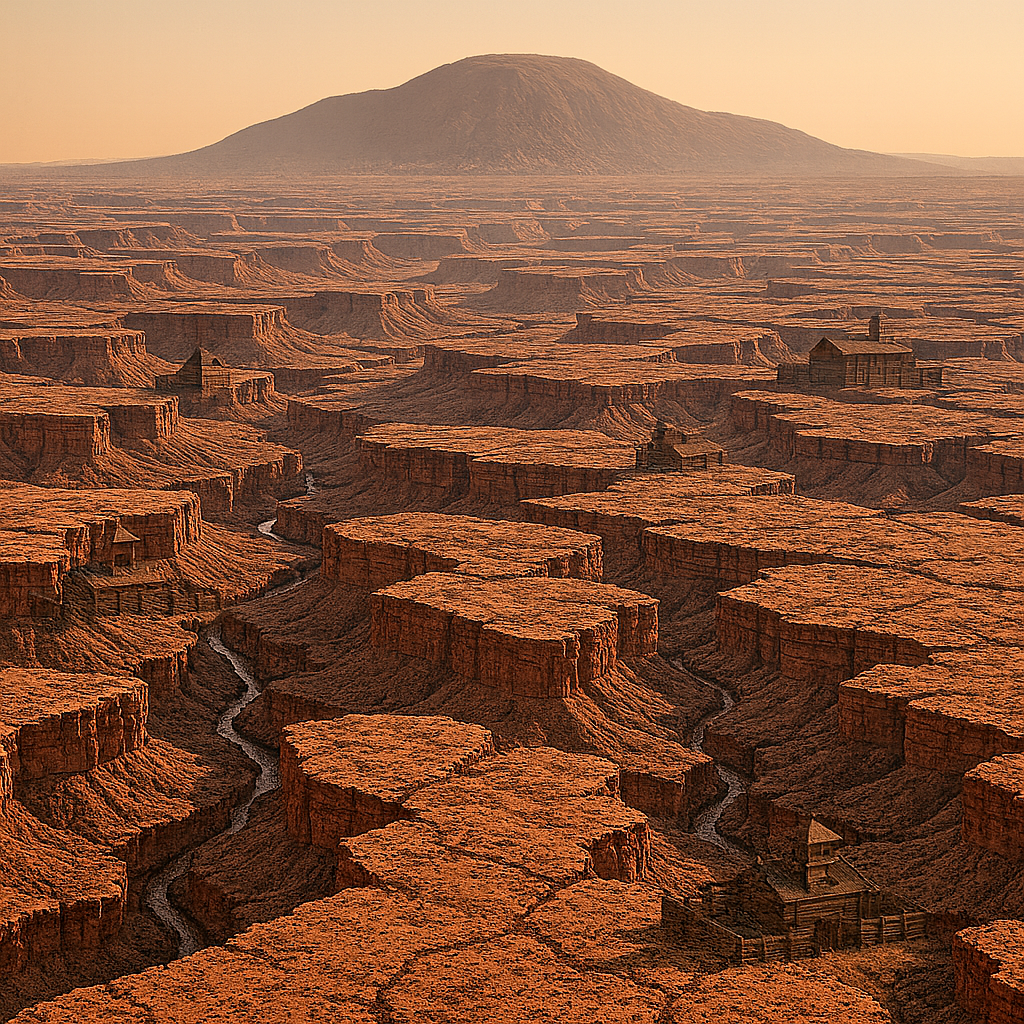
(Sadly, this is the best image ChatGPT can generate. So just imagine a thicker, stronger-flowing river, with each 'column of rock' a couple thousand meters tall.)
”We can conquer three or four thousand of them, and it still won’t be enough. The deeper we push into the canyon, the more nightmarish it will become to sustain the supply chain, but protecting ourselves is going to be the true catastrophe. How are we supposed to defend kilometers of scattered frontline while the enemy’s bombs obscure the sun and Griffin Knights striking our weak spots from every side, below included?” He bent the knee. ”I beg you, Strategós, for the love and light of Korinna—STOP THIS MADNESS NOW!” An Aetós Diós had his share of privilege, but with just a snap of his superior’s fingers, he could be immediately replaced and sent to live out the rest of his days in forced labor at one of the many re-education camps in the northern wasteland. Yet, despite knowing the notorious short temper of the Nephilim, he met his homicidal glare. Not to save his own worthless life, but for the lives of the thousands of soldiers he had sworn to protect.
“He is right, Xander.” Suddenly, an old man stepped forward, leaning on his walking stick. “Eight years ago, I witnessed many of your miracles. But even a hundred miracles would not be enough to conquer the Great Canyon.” He was Deínarchos Zachariádēs, the Stratēgós of the Liberation of Bloodmarch, who—despite his retirement—had accepted an advisory role for his successor. Thus, the old man’s words were enough to quell the tension. “All right, young warrior?” Dino asked, helping Zak to his feet and giving him a pat on the shoulder that carried an unexpected respect.
“Yes…thank you.” For a fleeting moment, the Aetós Diós thought of giving up, but when he looked into the violet eyes of his boss’s boss, he understood he could not. “Let’s retreat. There is no shame in it when we are doomed to lose,” he pleaded.
The man standing atop the high hill turned his head, casting them a pitying glance. His name was Xandér Xēoûs, also known as the Stratēgós of the Second Intercontinental Expedition, the Sovereign of Bloodmarch, the Scourge of the Rouge Family, the Terror of the Reactionaries, the Raven Nephilim, and countless other titles earned in his young yet already legendary life. Yet, the first title he received remained the one most remembered, which was born the moment people first set their eyes on his immense black hair and beard, both merging into a mane so striking it earned the name—The Black Lion.
“In your heart, you know he is right,” Dino pointed out.
“So, I ought to flee in shame while the enemy feasts on the carcass of my pride?” The Stratēgós turned his back to them, his eyes returning to fix on his objective.
”The lives of the soldiers you’re meant to protect are at stake!” Zak shouted. ”And even if you have some sort of master plan that could actually lead to victory, the cost in human lives would outweigh any possible benefit. Again, let’s try to pass by the Elvish ruins—whether we win here or there, the result will be the same. Please, I appeal to your reason, for I’m sure we both agree that our people are worth more than a piece of land!"
“Nah…” A bright smirk curled across the Black Lion’s lips.
“I’d rather win.”
***
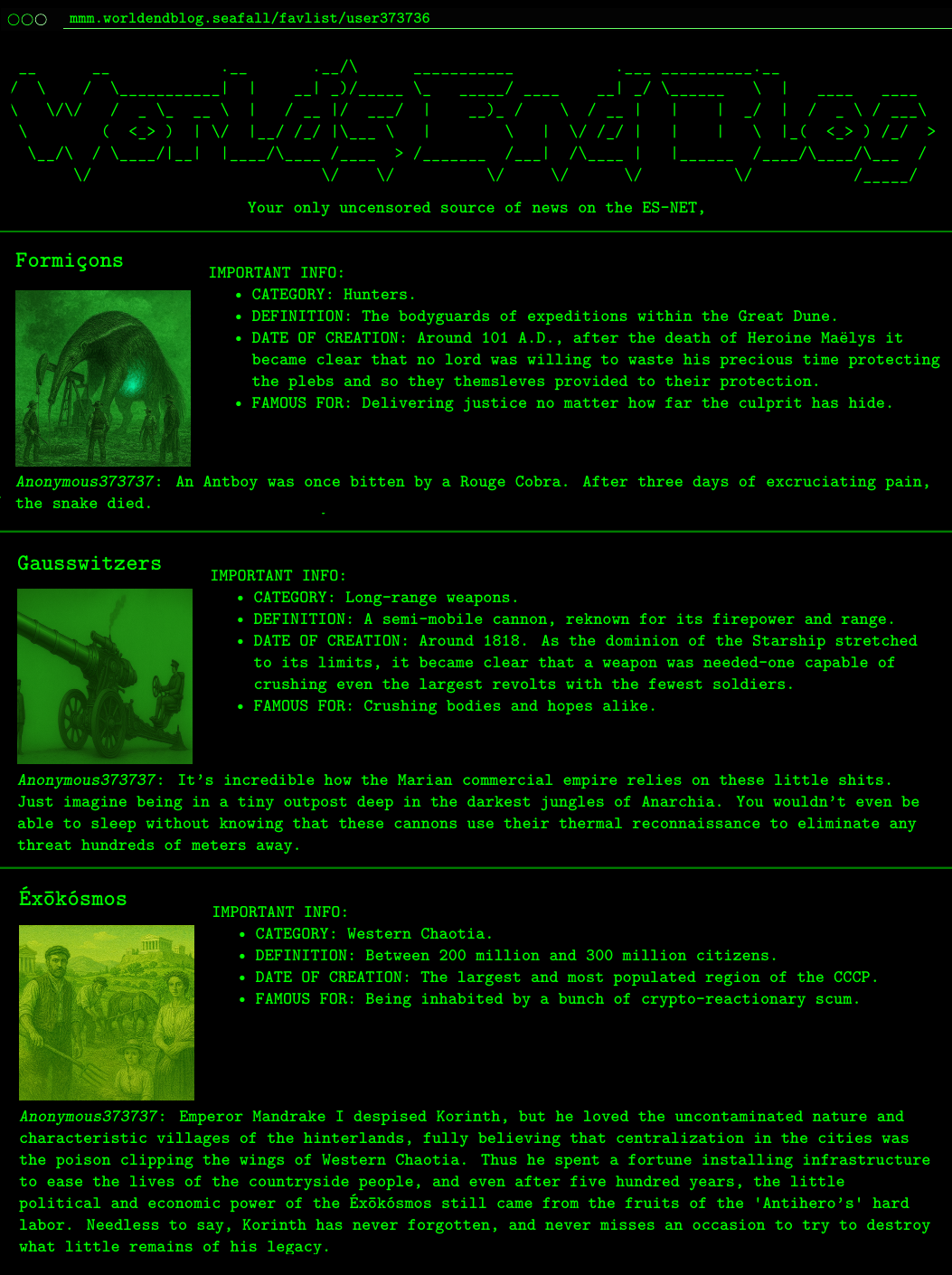
Tejuns was the name given to the Auxerine colonists who had settled along the coast of the Phoenix Gulf after its conquest by the callous hand of Heroine Maëlys. A fierce people whose skin and temperament alike were scorched by the harshest sun on the continent, bearing upon their shoulders the heavy weight of sustaining civilization itself.
From Suarez to Avalon, Magicbulbs, Hydrosystems, Hycars, and every other comfort of modernity was powered—wholly or in large part—by the Crude Mana extracted from the everlasting amount of wells buried beneath the golden sands of the Great Dune. Thus, despite their homes facing the sea, the Tejuns’ economy thrived in the hinterland, based on months-long expeditions deep into the desert to uncover hidden reservoirs of Mana and drill them.
Far from civilization and far from any legitimate force of law to shield the weak, the Great Dune was a battleground where countless predators fought to devour one another in order to survive another day amid that deadly desert.
The first were the animals—larger, fiercer cousins of their kind elsewhere, shaped by the ruthless natural selection of such a hostile land. The second were the monsters—horrors from darker dimensions, generated through the Gates opened when Mana Wells imploded. The third were the bandits—criminals who had fled into the only place where the hand of justice could not reach them. Three enemies, each with their own strengths and weaknesses, yet all sharing the same aim—to prey upon the wealthy caravans and their unlucky people that moved across their hunting grounds. Against them, the powerless merchants had only one hope to rely on—valiant knights who braved the chaos to bring order to the golden sea of anarchy.
They were known as—the Tejun Dune Rangers.
“Vous êtes les Rangers, vous vous êtes engagés pour mourir, et je vous envoie mourir!” Inside a fortress of dry wood and yellow stone, thirty-six Rangers stood at attention, listening to the chauvinistic roar of their Sheriff as he placed on his head a leather hat—his pride and most treasured possession. For all Formiçons—roughly translated from Auxerine as Antboys—it was the sacred symbol of adulthood, proof of the first beast they had slain and skinned. “L’ennemi est mille fois plus nombreux que nous, mais La Requine nous a ordonné de défendre cette base afin de lui donner le temps d’évaluer les dégâts du séisme causé par l’infamie de nos ennemis. Si nous échouons, toutes les lignes de front tomberont, et avec elles, notre Patrie!”
AA-Class 'Guillotine' Félix Tuetey De La Sèvre wasn’t a Tejun but a Châtelard—born in the comfort of a Château within the Lake Auxark. Scion to a fortune filthy enough to corrupt any soul, Félix decided, instead, to renounce his divine right and dirtied his body by enlisting with the Dune Rangers. Why? Love, of course—an unquenchable passion for a Phoenix who could never be caged. If dying today in battle meant she would read his name on a report, then it would be worth it.
“Rangers, avez-vous peur?”
*Bang!* *Bang!* *Bang!*
All Rangers drew their twin Tigresses from the holsters at their sides and soon they were joined by their leader.
“Rangers, assemble!”
With a tug at their leather belts, each adorned with a unique family emblem on its buckle, the Formiçons mounted their mighty Mustangs, eyes locked on the great wooden gate as it creaked open, revealing the road to both glory and death.
“Rangers, avant!”
At that command, thirty-seven Antboys rushed forth from the Monster-Hunting outpost to meet the Korinthian Phalanxes marching toward them.

The defenders had two main strategies to resist the invading army.
The first was to hop like rabbits from mesa to mesa, a relentless storm of hit-and-run attacks possible due to the Great Canyon’s unique geography, which forced the Korinthian Army to break into small groups to advance. Yet, this tactic came with a deadly risk—constant exposure to artillery fire—and no one truly knew how much the range of the Korinthian cannons had improved in the last eight years. Therefore, the Rangers settled down for the second strategy, meeting the Children of Korinna head-on—face to face—on the largest mesa near their position—the flat expanse where the Antboys’ hunting fortress had just emerged.
”[CHARISMA]!” The knights shouted in unison as a magenta wave engulfed their steeds, followed by sudden beams of light that wrapped horse and rider alike. When the light faded, their loyal mounts were gone, replaced by magical beasts.
The first notable change in the horses, aside from their notable increase in size, was flames now blazing where once had been forelock and tail. Each fire burned with a distinct color, reflecting the unique Mana their masters had infused into their souls—for example, one fire glowed as blue as the ocean and its flames moved like waves rather than flames.
The second difference was their hooves. As hard as diamonds, they cracked the ground as they struck it, their thunderous sound terrifying the enemy soldiers deploying across the canyon battlefield, who were unable to comprehend how something so heavy could move at a speed rivaling the swiftest Hycar.
And lastly, their skin. Some horses were as jagged and cracked as stone, others as smooth and gray as stainless steel. Among them, Félix’s steed was the most unbelievable—a shifting mass of wind, expanding and contracting with every stride, and although wingless, the beast was galloping through the air.
Witnessing the Knights of their bedtime fables charging at their positions, the attackers relied on their superior numbers to curb their momentum, dividing into three units to secure separate chunks of the mesas that stood between BLUE L.O.B.S.T.E.R. and the battlefield.
To move between these stone islands, the Korinthians had reverse-engineered the very concept of the magic shield. Men clad in high-[DEX] Basalt-Woven Armor, which featured boots powered by compact but robust air-jets, leaped across chasms hundreds of meters deep, landing hard on the mesas ahead. Once there, the soldiers nailed the three tubes knotted at their waists to the ground, and as water flowed through them, the Pipelines began to resonate, projecting flat Magic-shields that pointed skyward. Strong enough to bear the weight of an entire phalanx, the glowing-blue platforms stretched across the void, allowing thousands of soldiers to safely march from mesa to mesa.
That being said, none of the hovering bridges were wider than two soldiers standing abreast, and with no guardrails to secure their flanks, every step demanded caution—one careless slip could mean an anticlimactic death for a warrior trained for such an event.
The Dune Rangers capitalized on their slow deployment, charging straight at the leftmost unit, while the other two could do nothing but watch in horror as Knights on flaming horses brought the apocalypse to their comrades. However, the Korinthians who had already reached the mesa did not panic, and with practiced discipline, they stuck their human-sized shields—the Teîplons—into the ground. Each was a composite of layered steel, sand, and chipboard, pressed together into a thick and rectangular slab. Its edges, like puzzle pieces, bore recesses and protrusions that locked seamlessly with its neighbors, and one by one, they joined together till a thick azure wall rose to bar the path of the charging Antboys.
Unlike the Essentias—the blessed by the gods—the Giftless Soulfuls could employ only the most basic forms of magic, which were far too weak compared with true [Skills]. However, mortals possessed one overwhelming advantage over the deities—numbers. When hundreds cast the same spell, the so-called Resonance Effect fused their individual Mana into a single, formidable sorcery. Thus, the more shields that joined the formation, the larger and stronger the [RepellingField] grew, forming a towering barrier that spanned most of that battlefield’s section.
Once the shieldwall was complete, the Aspitēs impaled their Gaussbows into the backs of their shields, but instead of crushing onto each other, the two fused into one, allowing the soldiers to fire at the enemy without breaking the wall.
Behind them, the Dórytēs steeled the grip on their dozens-meter-long pikes as blue vapor hissed from the shafts, a sign that the Crude Mana within was boiling and that they were ready to impale any Essentia who broke through, or, more often, their armorless steeds.
Scattered across the neighboring mesas, the Bélētēs crouched with their Mazookas, ready to smooth the battlefield’s surface while protected by the hundreds of meters of void separating them from the main action.
Shield, spear, and stone, these were the three pillars of the Korinthian Phalanx, which, despite changing in practice, its theory had endured for two thousand years as the blueprint for the armies of Western Chaotia. It was the living proof that a powerful principle can survive the test of time, adapting to every new technological advance without melting beneath the intense yet short-lived flame of the candle that fools label with the word modernity.
”Rangers, à la ligne!” Being only thirty-seven against a Phalanx of several thousand men, the Tejuns knew the enemy had to be dealt with swiftly before they could regroup with the other two detachments now disembarking on the mesa. Hence, instead of attempting to smash through the formation, they spread into a single horizontal line, each Knight riding side by side with dozens of meters between them. ”Rangers, en joue!” Every right hand reached their [Inventory], drawing the same De L’Hôpital javelin. ”Rangers, faites feu!” In perfect synchrony, they threw their weapons at the shield wall, each strike landing at the same height and at the exact same distance from one another.
*kaaaaaaaaaaBOOOOOOOOOOOOOOOOM!*
Physics is democratically free to learn and use by all, and so the very Resonance Effect that had forged such a formidable barrier became its doom. All thirty-seven javelins struck with only microseconds between them, so the force of their blast multiplied exponentially, breaking the bearers’ grip on their shields and pushing them to the ground.
Only one Korinthian remained on his feet, the man who led the Phalanx at the very tip of the formation—the Aristeús, a role reserved for the most determined of soldiers because it meant enduring the brunt of every assault against the shieldwall. ”RISE! HOLD THE LINE FOR THEIR CHARGE!” He roared, slamming his human-sized shield back into the ground. However, when the veteran turned his head, he saw only crying babies fleeing their first battle, leaving him to stand all alone. ”You…IDIO—” Before the Aristeús could curse them, a whip lashed around his neck and tightened, severing his head from his body.
His name was Athánasios Kostas, a thirty-seven-year-old war hero of the Liberation of Bloodmarch, decorated with multiple medals of honor for single-handedly saving his Phalanx from a Class S eight long years ago. After the war, he had married his childhood sweetheart and fathered four children—three daughters and a son—investing the earnings provided by his newfound popularity in a repair shop to help the people of his rural hometown adapt to changing times. Every year, he saved a third of his income, determined to send his children to the best university in Korinth—his dream was to one day sit in the crowd and watch their graduation. Thirty-seven years of joy, pain, and love now lay broken in the dust, their remains now trampled by their killers.
That being said, the fate of the cowards was not much better. Despite the Bélētēs’ desperate attempt to save their comrades with volleys of explosive shells from their Mazookas, the Essentias of the [Mage.Ring] calmly focused their long-range [Skills], sniping with their [ManaSpheres] each shell before it could land, and with their artillery silenced, the Antboys were free to charge, cutting through the Aspitēs and Dórytēs like a combine harvester through a field of grain.
The Korinthians who survived that first onslaught quickly turned on one another, shoving comrades off the narrow bridges in a mad attempt to save their worthless lives. The lucky ones met instant death—their bodies shattered against the rocks after a two-thousand-meter fall—while the unlucky ones were caught mid-air by the claws of the horrors lurking within the labyrinthine columns of the Great Canyon, screaming with all the air left in their lungs as they were dragged into the shadows.
Witnessing their comrades’ doom, the Bélētēs began retreating across their mesas in calm and order, believing themselves untouchable due to the hundreds of meters of void between them and the battlefield. However, their confidence shattered when a single Knight charged straight at them, frightening as his steed’s hooves trotted across the air itself without falling, and in a matter of seconds, the beast carried him across the gap—being able to ride across the mesas as if they were open prairies was the only reason why Félix, despite his young age, was chosen as the Great Canyon’s Sheriff. Then, the rider unleashed two whips of compressed wind—-air writhing within them as violently as in a tempest—that stretched across the entire length of the mesa before twisting violently, severing all the artillerymen into two halves.
The clash between thirty-seven Rolandish knights and five hundred Korinthian foot soldiers left more than two hundred Soulful dead while the Essentians suffered no casualties.
“Rangers, assemble!” The Formiçons regrouped and galloped toward the next Phalanx, and by this point, the Korinthian strategy was clear. As the Rangers busied themselves annihilating the leftmost unit, reinforcements poured in to bolster the rightmost, while the central Phalanx was left with only one task—to hold the line long enough for the thousands behind them to organize. As the thunder of hooves drew closer, the Korinthians exchanged solemn glances, each praying to the Holy Trinity that the enemy had no javelins left.
*Sssssshhhhhhhhhh!*
A sudden gust swept dust into their eyes, and when they blinked it away, the world had turned silver. At first, it seemed like a harmless glimmer of light, but soon the argentine air-stream began to circle, faster and faster, until the men found themselves weightless as their boots no longer touched the ground—the storm had grown into a full tornado, centrifuging the soldiers along with their shields, weapons, and armor and none of their pleas for help could be heard outside. Some of the soldiers got their skulls crushed against their own shields, others were propelled out of the vortex, and only a lucky few landed safely instead of breaking their necks.
In mere seconds, of the seven hundred soldiers in the central Phalanx, fewer than a hundred survived. It was a total defeat, but the worst part was that they died without ever knowing who, or what, had killed them.
“What has…just…happened?” Zak stammered, his gaze fixed on the crooked corpse of a soldier who, only seconds before, had been kilometers in front of him. Then, his moonlight eyes—red, green, or blue depending on some inexplicable natural rule—shifted back to the Argentine tornado, now compacting into a rotating sphere, its winds rushing faster and faster as its glow turned incandescent. “Wings…” Inside the compact storm, something became visible—the glowing silhouette of a colossal bird, and, upon its back, stood a lone knight.
“What’s happening, young warrior? She is finally here.” Dino smirked. Although blind in both eyes, he could not mistake the incense-like scent saturating now the air—the same he had first breathed eight years ago, on the day his total triumph was stained. “Isn’t it poetic that to achieve Heroine Korinna’s dream, we must first kill the reincarnation of her dearest friend?”
The Aetós Diós swallowed hard, terror exuding from his tone. “No…it’s impossible…she shouldn’t be here—not yet, not now!”
“You are the smartest man alive, and you still fail to grasp a concept as simple as a woman’s intuition?” Xander’s emerald eyes blazed, his retinas scorching as he focused on the argentine glow. From his vantage atop the high hill, the battlefield resembled a chessboard. Two pawns had fallen, but in chess position is everything, and that was a small price to pay to expose the queen.
*Kreeeeeeeeeeeeee!*
A high-pitched shriek ripped through the air, so sharp it forced every soldier—except the Strat gós—to clasp their ears in agony, a desperate attempt to shield their eardrums from exploding.
*SHHHRRRAA-CRRAAAACK!*
Next, the sphere of argentine wind detonated, unleashing a shockwave so powerful it reached the high hill, making all officers’ backs kiss the ground—except the Strat gós. When they rose and opened their eyes, they witnessed the true owner of that silhouette—a knight upon his griffin. It would have been a typical sight on any battlefield, if it weren’t for one small detail. The gigantic bird was something the world had almost forgotten for two thousand years, the last of its species—a Phoenix.
She sported a majestic plumage, adorned in an unquenchable flame released from the tips of her feathers—metallic-like with a blazing tip, like ingots in a forge just before melting. A mist, argentine and incandescent, evaporated from her plumes, as if the Phoenix’s body was constantly burning and regenerating—an endless cycle where both life and death lost their standard meanings. Both the Tejuns and the Korinthians had their eyes bewitched by the vision because there was no doubt of her identity—all Chaotia, East and West alike, knew her name. She was a living relic of their heritage, the last of the three Phoenixes who once fought alongside Hero Roland and his Holy Companions against the ‘Twilight Queen,’ whose head still adorns the Emblem of the Holy Rolandish Empire—Béatrice, la ’Colombe Romantique.’
“She’s even hotter than in those Secret Service photos. Too bad I’m already engaged,” the Black Lion muttered, a flicker of regret for his old single life crossing his face as he admired the strawberry atop the cake.
“It must be scorching in there,” Deínarchos sarcastically remarked at the sight of Béatrice’s argentine flames that shrouded the female Knight like an ethereal cloak, setting her armor ablaze together with the long braid that spilled from the hole atop her helmet. Her hair, best described as desert sand—a shifting blend of red and yellow hues—did not burn. Instead, the silver fire enveloped them like a halo, elevating her into a goddess.
“So she is the reincarnation of Heroine Maëlys…” Zak gulped, fully persuaded that the beauty he was now witnessing was one of the so-called Mirage Nymphs who lured unlucky wanderers to their doom in the desert. “S-Class ’Geo Composer’ Freawyn Rougedior, La Requine de la Marche.”
Freawyn was encased head to toe in her Pearl-Sculptured Armor—white as milk, yet blooming a rainbow hue wherever sunlight kissed its surface. It was the only Sculptured Armor ever forged for a human, a gift from the ’Romantic Dreamer’ herself to Heroine Maëlys—La Pérégrine. However, the ’Geo Composer’ had despised it with every fiber of her being. Why? The sabatons ended in high heels. The lower portion of the armor was shaped like a fashionable skirt. Her arms, legs, and neck were sculpted as slender as a ballerina’s, creating uncanny yet divine proportions. And the chestplate…well…let’s just say there was far more chest than plate.
“What a pretty jewel we have there,” the Black Lion sneered. “If luck’s on my side, I’ll take it from her bloody corpse and give it to my girl as a wedding gift. What do you say, Dino?” His sensei might have excused such bravado if Freawyn had been a man, but despite the changing times, killing a woman—even such a strong warrior—was still viewed as somewhat ungentlemanly.
As the mentor schooled his disciple, Zak slowly raised his trembling arms. “I-It’s just me…or is she staring at us?” He stammered as Freawyn pointed her bizarre jousting lance at them—a cone-shaped weapon carved with a continuous spiral groove, wide enough at the tip for a small ball to roll down.
Black hair and beard, towering stature, emerald eyes—it seems the blue king has exposed himself.
[Perception] allowed Essentias to spot targets hundreds of meters away, but for a Class S with [PER=477], looking at enemies kilometers away was no different than seeing them from a couple of meters. Thus, Freawyn could clearly read the expressions on the faces of those gathered on the high hill, including the smugness of the Strat gós.
Let’s see if I can wipe that damn smile off his face.
With a single, fluid motion, she launched her lance into the mesa beneath her, cracking its surface and burying it deep into the stone.
“She’s surrendering already?” Xandér laughed. “C’mon, that’s pretty anti-clima—”
*WooooooommmBWWWWUUUMMMM—KRRRSSHHHH!*
The earth roared as a violent quake ripped through the valley, knocking the inhabitants of BLUE L.O.B.S.T.E.R. to their knees and stealing their balance for what felt like endless seconds. Yet, when the tremor finally subsided, their terror only deepened because a titanic nightmare loomed in the sky.
An entire mesa had been uprooted from the Great Canyon—a two-thousand-meter-tall column of stone, weighing over 300,000 tons, now hovering ominously beside La Requine de la Marche and her argentine Phoenix.
“Oh, Romantic Dreamer, forgive me for my sins.” The Aetós Diós collapsed to his knees as the floating mesa shattered into millions of fragments, darkening the sky and eclipsing the sun as Freawyn’s lance flew back into her hand.
“Stay close to me if you want to live!” Xandér wailed, and Zak desperately clung to his massive leg like a sailor gripping the mast of a sinking ship, while Dino calmly stepped behind the large back of the Raven Nephilim—together, the three braced for the total annihilation.
With a single downward swing of her weapon, the Requine commanded every shard of stone—some no larger than pebbles, others as massive as boulders—to rush forward, straight at the enemy—a meteor shower raining from the heavens to punish the sinners who had rejected the many virtues of Hero Roland for the deceitful words of Heroine Korinna.
*CLUSH!*
The first stone slammed into the high hill, striking only meters below them, and the shock of the impact was strong enough to make Zak wet himself.
*THWUMP!*
The second whizzed past their faces by mere centimeters before smashing into the officers behind them—their flesh, blood, and uniforms plastered the soil, causing the Aetós Diós to vomit. Then came the third, then the fourth, and then hundreds more flew over the high hill, crashing into the thousands of tents in BLUE L.O.B.S.T.E.R.
As the apocalypse rained down upon them, some Korinthians froze—paralyzed as their dilated pupils mirrored Hero Roland’s judgment—while most filled the air with a cacophony of terrified screams, each one punctuated by the thunderous drumbeat of impact after impact. Yet, even that dreadful and loud symphony could not awaken the thousands still asleep, dying in bliss as the growing fire swallowed their tents.
Zak wept as he watched his comrades fall one by one, cut down as easily as wheat beneath a scythe. However, his grief was brief. Turning toward the direction everyone on the high hill was now staring at, he witnessed in horror the largest of those rocks descending toward them. He closed his eyes, and with a final breath and a whispered prayer, the Aetós Diós accepted his death.
*BANG!*
Suddenly, the boulder exploded mid-air, its fragments scattering across the hill and striking some minor officers, but the trio at its heart remained untouched.
*BANG!* *BANG!* *BANG!*
“Why was it so slow?” Xandér growled as each shard, one by one, turned into clouds of dust. ”I’m going to report those engineers to the Martial Court—that Reactionary whore nearly got me killed!”
Perched atop the rocky hills encircling BLUE L.O.B.S.T.E.R., batteries of magical cannons connected by a shared pipeline fired in unison. Each shell was a condensed core of Crude Mana, launched at anything their Algorithm flagged as an unauthorized object in the assigned airspace.
Together, these weapons formed the air-defense system that featured an Integrated [OS] to coordinate its hardware and software, a Centralized Pipeline physically linking its various hardware, an Automatic Algorithm for decision-making, a radiation-based Aiming Software, an Uninterruptible Power Supply capable of running 36h/12d, and a Synchronization Software that assisted without slowing down the Korinthian Army’s hydro-systems.
It was known as—KILLING I.C.A.R.U.S.
Only a third of the planned firepower had been installed, and the system still required a lengthy initial calibration. Yet, once operational, it performed its task with lethal efficiency, vaporizing millions of meteors and saving BLUE L.O.B.S.T.E.R. from total annihilation, and although the rocky barrage claimed more than three thousand lives—mostly civilian contractors—Killing Icarus had intercepted over 78% of the debris—a more than acceptable result.
“She’ll strike again, and half of these cannons will be overheated by then—we must escape n—” The Aetós Diós cried, tears streaking his face as he yanked his boss’s leg, only to be shoved aside by a kick from the Strat gós.
“I thought you had the highest IQ in the world, so stop being a fucking retard and use that gifted brain of yours for once.” Xandér snapped, now starting to regret his choice of successor. “Yes, this shitshow is going to weigh on our morale for a long time. However, there was no real plan behind that attack, just the childish theatrics of Reactionary scum. Like the filthy animals they are, Essentias believe brute force alone is enough to submit the enemy, unable to understand that while their genetic gifts may enslave the body, only ideas can conquer heart and mind—once people taste freedom, no fear can reforge the broken chains.” Xandér argued as he drew his Emerald Tigress—affectionately called by him Matryoshka—and loaded his sweet girl with an orange bolt.
“Freawyn Rougedior embodies everything wrong with Reactionaries. She is an Auxerine princess born in the most luxurious of Châteaux, who, bored with the wealth squeezed from her slaves, chose to dump all her responsibilities onto her younger sister—ruining her life forever—just so she could play at being a Valkyrie in this desert. A spoiled noble yesterday, today, and tomorrow—she will always be the same. However, this time her caprice has cost her dearly. After that shitshow, her [MP] must be drained, tripling my plan’s chance of success. And now—it times to capture the queen.” He fired, staining the sky with an orange cloud.
*Kreeeeeeeeeeeeeeeee!* *Kreeeeeeeeeeeeeeeee!* *Kreeeeeeeeeeeeeeeee!*
A multitude of high-pitched shrieks heralded the arrival of the only piece on the chessboard capable of rivaling the queen—the Knight. From the orange cloud, a hundred Wyverns emerged, swiftly encircling La Requine and Béatrice, orbiting around them from every direction until a spherical prison took shape, leaving no hole for her to escape.
The wanna-be dragons were three times the size of the Phoenix, their black, brown, and dark-green scales sturdier than steel and capable of absorbing even the most violent explosions—toys like Mazookas were completely useless.
Upon their backs were the Sky Nomads—clad in the Harmonized hides of the Kaiju they had slain in the Mediterranean Ocean—taunted the Auxerine princess with untranslatable insults. All except their leader, who remained outside the living prison, dipping it into his own blood to an ancient-looking and oversized brush to paint colossal ideograms over a scroll—one beneath the other—the only Adamic word among them was—Freawyn.
I’ve never killed a Lawfullian before. I wonder which of them I should embalm and keep in my trophy roo—
*DING!*
Just as La Requine de la March prepared herself for the massacre, the scroll vanished from the Sky Nomad’s hands, followed by the sound of a notification.
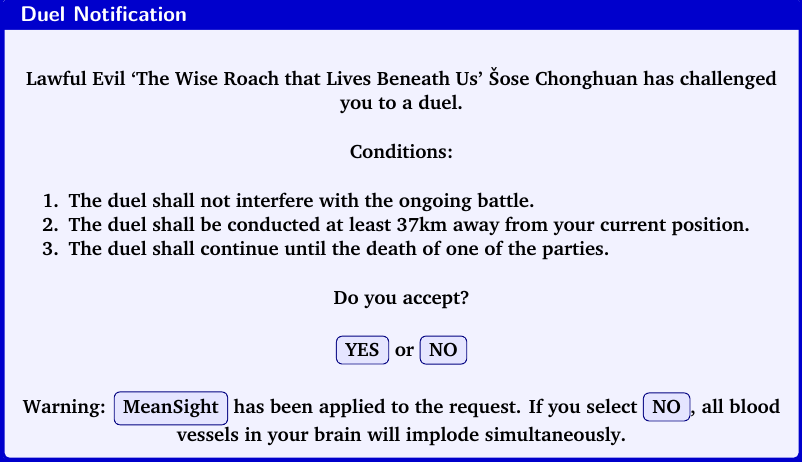
Damn Legalists and their dirty tricks!
The ‘Geo Composer’ cursed the Lawful Gods as she clicked [YES]. Then, as the duel’s rules acceded, she proceeded to leave the area and dove toward the bottom of the Great Canyon. She chose the labyrinthine structures as a battlefield to counter the enemy’s superior numbers with the narrow corridors between the Mesas. Flying there was like galloping a horse through a forest—one small mistake, and she would smash straight into a column of rock. Nevertheless, within that maze of stone, Freawyn was at home.
Now it’s all on my shoulders. If I survive here…maybe she…
Félix drowned in his own fantasy, while his Rangers grimly realized they were alone against the last yet largest pocket of the Korinthian Army.
Five thousand Aspitēs and Dórytēs in total, divided into three Phalanxes—three triangular fortresses of men standing shoulder to shoulder—supported by a thousand Bélētēs and the thunderous wrath of the Le nídas Model 1991 Gausswitzers—cannons with a twelve-meter barrel and an ergonomic firing station from which its operator could calibrate power, type, and trajectory.
“Rangers, à l’attaque!” Félix roared, and the Tejuns split, too, into three groups of twelve Four-miçons each.
The [Monk.Ring] group advanced first, their [Passive.Skills] turning them into Tanks as they absorbed the volleys of bolts unleashed by the Gaussbows embedded in the Aspitēs’ shields. Reload, aim, fire—over and over again. The shieldmen carried out their duty with mechanical precision—like gears in the same machine—hammering at the Rangers’ defense until the enemy was close enough, then they shifted their focus to their shields, leaving the shooting to the comrades behind.
The [Mage.Ring] group held the rear, with half channeling their Mana into sustaining the [RepellingField] as Bélētēs’ Mazookas crashed against it, their high-[INT] shots cracked the barrier but failed to shatter it. The other half used their [Mana.Spheres] to intercept the Gausswitzers’ shells mid-air, turning them into harmless fragments before they could break the formation.
It didn’t matter how much firepower the Korinthians spent to slow them down, the Rangers inevitably reached the point where the artillerymen could not risk friendly fire, and now it was the Rolandish turn to attack. The Monks and Mages clashed with the long pikes of the Dórytēs, weapons that either exploded on impact or could be ejected like fireworks, each one overflowing with Negative-Frequency Mana specifically engineered to counter the Positive-frequency Mana within an Essentia’s body—their clash producing violent shockwaves that aimed to knock the knights from their saddles.
Nevertheless, the Essentias’ [DEX] was too high, and slowly but steadily, lancer after lancer fell, forcing fresh soldiers to abandon their positions to close the gaps, and when a section of the Phalanx got exposed enough, the Essentias of the [Warrior.Ring] materialized—or drew from their [Inventories]—their weapons—swords, spears, maces, etc—charging into the weakest segment of the shieldwall. Their magic beasts easily trampled over the shieldmen, hooves crushing the enemies’ spines beneath their own shields, and once the wall was shattered, the Formiçons broke inside the Phalanx and the slaughter began.
There, surrounded on all sides, the Antboys swung their weapons and unleashed their [Skills] on all sides, killing everyone unlucky enough to stand in the path the Rangers were carving violently throughout the triangular formation. Yet, reinforcements soon poured in, hundreds of Dórytēs rushing in to save their comrades, and when their numbers increased enough to threaten the formation, Félix raised his saber and ordered the retreat. The Warriors charged again at the weakest point of the wall, smashing through the shield-bearers and riding back to their original position under the cover of the Monks and Mages, who stopped the new storms of artillery fire raining down from the rear.
However, one young Antboy—C-Class ’Raging Hawk’ Pier Thorent—succumbed to his thirst for blood and broke formation, remaining inside the Phalanx. Without the protection provided by his companions, soon his horse was struck by a pike, and the subsequent explosion propelled both to the ground. In less than an instant, dozens of Dórytēs jumped on him, stabbing his body with their pikes before hastily retreating. For a brief moment, the weapons glowed like molten iron, then they blasted into towering columns of raw energy, whose power was exponentially multiplied by the Resonance Effect, annihilating Pier along with the unlucky lancer too slow to escape in time.
None of his fellow Rangers moved to save him, their honor bound by the most sacred rule of the battlefield—he who breaks the formation shall die.
When the dust settled, the Korinthians replaced their fallen Aspitēs and Dórytēs with fresh shieldmen and lancers, while the Rolandish repositioned themselves to face their enemy once again—both armies now stood in their original positions, as if nothing had happened at all. Yet, this was how wars between Eastern Chaotians and Western Chaotians had always been fought—a maddening dance of near-equal exchange until either the [MP] of the Essentias or the ammunition of the Soulfuls ran out, deciding the victor.
Meanwhile, in that thick forest of stone beneath both armies, there was no straight road, only a labyrinth of short and serpentine paths, where a single mistake meant smashing against a colossal mesa. Thus, taking a turn too quickly was the most dangerous and most suicidal thing one could do.
That being said, with dozens of Sky Nomads hounding her, Freawyn was forced to zigzag aggressively and hastily throughout the Great Canyon while fending off their brothers lying in ambush ahead. At every new turn, more enemies awaited her, blocking the route and forcing La Requine to devise a plan in mere fractions of a second before either crashing into a column of rock or being unhorsed by their assault. Nevertheless, none of Šose’s minions could truly match a Class S head-on and Freawyn easily won every clash, but the real problem, however, was their mastery of hit-and-run tactics—the Sky Nomads always withdrew before she could finish them, escaping with mere bruises after landing a few precise blows. Each skirmish drained her precious [SP] and [MP], and she couldn’t even catch her breath before new foes were ready to strike her at the next turn. A continuous flow of droplets, with enough patience, could fill an ocean, and Béatrice, if nothing changed, despite her immortality, would sooner or later burn herself to rebirth, leaving her Knight defenseless.
How could the Sky Nomads never lose sight of La Requine and ambushing her again and again without missing once? One major factor was the Korinthian intelligence reports on Freawyn, which had studied hundreds of her battles and analyzed her habits, preferences, and tendencies, programming a probabilistic Algorithm to predict her most likely next decision. However, the true secret was the unique [Build] of Šose Chonghuan himself. With it, he could materialize a [Window] displaying the entire map of the Great Canyon, every canal and passage traced in a lighter hue across its bluish surface, while glowing red points marked each moving body—updated in real time—including Freawyn and Béatrice, whose silver point shone on his display.
Šose shared this [Window] with all his goons, granting every Sky Nomad omniscient view on the battlefield, which gave them a vital advantage to continuously put pressure on their target. Thus, no matter how fast La Requine flew and no matter which canyon she chose, the ’Wise Roach’ and his swarm always held the upper hand. However, the main problem with trying to outsmart a god is that they see the world from a higher perspective than foolish humans.
Animas are the best at duels, Legalists are the best at team fights, while we Essentias are second-best at both. But war is chaos, and we are its children!
A funny idea sparked inside the Auxerine Princess’s mind, but for it to work, she would have to write an [Email] and geolocate Šose somewhere within hundreds of square kilometers, all while fighting for her life against his minions and avoiding a fatal collision with the mesas—nothing could be simpler.
”[Microseism].” The ’Geo Composer’ whispered, releasing an earthquake so weak that no living being could perceive it. The wave dispersed easily throughout the Great Canyon without being weakened by its complex morphology, scanning every centimeter of the area. With her absolute ear, La Requine could now listen to the symphony of this land and to the many stains corrupting it. She heard the chaos of soldiers struggling to quench the fires raging in BLUE L.O.B.S.T.E.R., the clash of the two armies above, the Sky Nomads closing from behind, and the ones lying in ambush ahead. But she also heard something else—the faint groan of a kraken, its tentacles wrapped around each nomad. ”Found you!” Šose’s hiding place was uncovered in less than a minute, and without wasting a second more, Freawyn drew her pearl Tigress from [Inventory] and fired a crimson bolt into the sky.
“Mmh…what does that mean?” Xandér thought aloud after a firework exploded in the sky, releasing red sparkles. He stared at the battlefield for a couple of minutes, failing to notice any change until his sight fell on the hunting outpost. “Where did the cannon go?” A chill ran down the Strat gós’ spine, prompting him to grab his Matryoshka and fire a blue dart into the sky.
“His Azure Eminence—THAT’S A TRAP!” The Aetós Diós screamed, clinging desperately to his superior’s leg.
“Our cowardly friend is right. That’s bait, and a very low-quality one,” Dino stated the obvious.
“Probably both of you are right.” The Black Lion drew in a deep breath, his emerald eyes gleaming. “However, now I’m curious. How is she planning to fuck with me? I’ll never know if I don’t take the bait, will I?” As the words left his mouth, a new cacophony of hooves thundered across the battlefield.
Clad in azure plate—riders and mounts alike encased in the same steel—they darted across the mesa, using the Phalanx as a living wall to block the Tejun Rangers’ attacks. Advancing in an edge formation, their armor gleamed with the blessing of the blue sun—its radiance mirrored in the steel. They were the champions of the Soulfuls, who—thanks to their heavy armor, magic-enhanced weapons, and fanatical training—were the only Soulfuls capable of meeting Essentias in direct combat and living to tell the tale—the Kataphracts.
Once the Korinna’s Knights ran past the hunting outpost, they spotted a human caravan pushing heavy wagons toward a bridge that linked the battlefield to another mesa guarded by a fortress.
It seems the Rolandish are attempting to withdraw their forces in secret.
A Kataphract reported via [Email] to the Black Lion.
“What are you waiting for—KILL THEM ALL!” Xandér roared as he wrote the reply.
His loyal Champions obeyed, charging straight at the center of the convoy. “P-please, n-no—” The Kataphracts ignored the begs of the hooded figures as they unsheathed their massive swords, striking at them with merciless precision. However, something felt off to the Korinna’s Knights—none of the Reactionaries had tried to fight back.
A single swing of a Zweihänder severed a head cleanly from its shoulders, and as it rolled across the ground, it revealed not the face of a seasoned soldier but that of a withered old woman, and horror spread through the Kataphracts as more heads followed—all of women, the elderly, and children. “Oh, no…” The Kataphract captain turned his head at the fortress behind, his eyes blinded by the sunlight reflecting off the sharp steel. “EVERYONE, R—”
*BOOM!* *BOOM!* *BOOM!*
He was silenced as a devastating volley of Mana Spheres, fired from the fortress behind the hunting position, buried him and all the Korinna’s Knights. In an instant, the entire squad of Kataphracts was obliterated, along with the few Rolandish civilians still alive.
What followed was pure chaos. The survivors poorly communicated their reports, overloading the communication channels with fragmented and distorted information, spreading panic through the Korinthian lines—exactly as Freawyn had planned.
”[LiveDrilling]!” La Requine de la March touched the shaft of her cone-shaped jousting lance, releasing an argentine wave that set it spinning faster and faster. Then, instead of turning right or left, she flew straight toward a mesa, impaling her weapon’s tip into it, and as the spiraling motion drove the lance deeper and deeper into the rock, the ’Geo Composer’ and her Phoenix let their bodies flow with the centrifugal force, dissolving into a silver vortex that drilled deep into the stone.
In mere seconds, the living auger penetrated through a hundred meters of rock, re-emerging on the other side while leaving behind a long tunnel. However, she did not stop, driving straight into the next column and carving another tunnel through its solid stone. Then, another time through a mesa kilometers long, and when La Requine finally emerged from the last tunnel, she found herself face-to-face with a shocked Šose. He tried to flee, but was too slow, and the silver vortex hit directly into his head, drilling through his skull as if he were just another mesa.
The [Qi] of the Legalist quickly ran out, and with no more currency to extend his [Life.Contract], his neck was severed, leaving only a headless body to tumble into the river. “Oh no, I’ve ruined my trophy.” Freawyn sighed as she glanced at the mass of meat that had once been the head of the ’Wise Roach,’ now stuck on the tip of her weapon. Regardless, she immediately proceeded to sever the head of Šose’s Wyvern. “Better than nothing, I guess.”
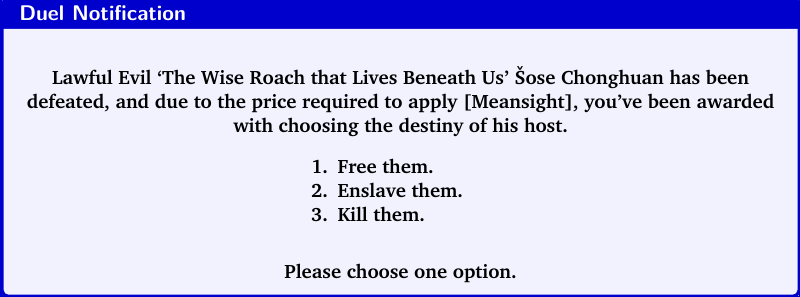
As the brain vessels of hundreds of Sky Nomads imploded in unison, a silver firework signaled La Requine’s new orders. Seeing it, the Rangers disengaged from the Phalanx, retreating, along with the garrison of the hunting outpost, to another Mesa. The Korinthians, unsurprisingly, offered no resistance, and within twenty minutes all the Rolandish forces had crossed the bridge, which they swiftly proceeded to demolish.
3 Tejun Dune Rangers and 122 civilians perished on the Rolandish side. The Korinthians, by contrast, counted 5,434 dead—rough estimates obtained from aerial photographs.
“Meh, it could’ve gone worse,” Xandér shrugged, already busy imagining the half-full-glass headline he would feed the journalists.
“Worse?”! We’ve lost more than thirty Kataphracts, an entire Host of Sky Nomads, and half our headquarters is in ruins—WE HAVE BEEN UTTERLY DESTROYED!” Zak shouted with all the strength left in his body, but obtained only a casual whistle from his superior. “Oh, forgive us, Holy Trinity…” he mumbled, clutching his temples. It was his first battle, and the crushing weight of thousands of deaths pressed on his conscience, feeling responsible for his failure to stop the Strat gós’ madness.
“We went eight years without war, and our army was fattening and dulling in the meantime,” Dino explained, leaning on his stick. ”Just five thousand deaths in the very first clash against the reincarnation of a Holy Hero? All things considered, I’d say we did a good job.”
*Kreeeeeeeeeeeeeeeee!* *Kreeeeeeeeeeeeeeeee!* *Kreeeeeeeeeeeeeeeee!*
As Dino finished speaking, three wyverns descended to the high hill, and from their backs leapt three Korinthian officers, who landed with grace and saluted their Strat gós as they rose.
“Oh, hell—” The Aetós Diós began, but they just stared at his wet pants in visible disgust before turning their attention to Xandér and Dino, offering a military salute.
“His Azure Eminence,” said the eldest of the trio, his voice, expression, and manners as polished as silverware before a banquet. “Solid advancement for my army. It seems your choice to use yourself as bait has worked well.” He was Eikṓn Sképsis, the golden boy of the special forces, credited with more successful operations during the Liberation of Bloodmarch than all his colleagues put together. When the Second Transcontinental Expedition was approved by the Chairwoman, he had been one of its principal architects, personally drafting the list of the finest men to command each organ of the new army. However, the man standing before him had thrown all those carefully crafted lists in the trash, opting, instead, to assign each position by lottery, and Eikṓn found himself commanding a group of reservists instead of leading the construction and organization of BLUE L.O.B.S.T.E.R.. ”They may have won this battle, but they’ve lost the war.” Needless to say, he despised the Strat gós. Yet, for now at least, he complied because his true target was the puppy now clinging to Xandér’s leg. After dealing with him, he would turn on the bitch.
“After securing the war targets, I took the initiative to raid several of their bases and confirmed the intelligence reports about the enemy’s manpower shortage,” reported Genesía Delphýs, a rising star who graduated top of her class and became the youngest woman to ever obtaina the Medal of Honor—a, somehow, easy accomplishement since the Liberation of Bloodmarch was the first war fought after the abolition of traditional gender roles. “My honest advice is to eat the penguin while it’s hot, and conquer L’Havre Délaissé before the Starfleet arrives.” The Snowwoman was taller than everyone in sight, with the sole exception of the Raven Nephelin—her expression as cold and unreadable as ice, whether Genesía spoke of the casualties or the triumphs against the enemy.
“We can win every battle we fight, but to conquer the Great Canyon, we must do more than defeat the Reactionaries on the battlefield,” interjected a small kid in a tailored uniform that still seemed slightly out of place on a toddler. “I recommend a three-pronged assault—from the river below, from the mesas, and by dominating the skies. If we bait Lady Rougedior into concentrating her forces in one sector, she will no longer be able to stop the domino.” His name was Markos Apostatēs, a ten-year-old boy genius with an IQ exceeding two hundred. Markos was the product of the experiments conducted under Project Hēmithéou, and now, he had become the expedition’s walking brain.
All three harbored a deep hatred for Zak because they had once been candidates to succeed to the position of Aetós Diós, a title that went far beyond the battlefield, carrying immense prestige and political dominance for the faction that secured it.
Ike was the protégé of the Bureaucratic Class, who saw the office of Chief of Logistics as a springboard for his eventual rise to Chairman of the Eleutheria Republic.
Gene was the daughter of one of the wealthiest landowners of the Éxōkósmos. Her appointment was meant to break Korinth’s stranglehold over state politics, bringing in a new era where the long-neglected outskirts would finally gain the respect they deserved.
Mark was the masterpiece of the Magical-Industrial Complex that dominated the Korinthian economy. His backers intended him to clean their nation from the lazy bureaucrats and the regressive farmers alike, to lead Western Chaotia into a new golden age of technology—the only weapon they deemed effective against the Essentias.
On the day Operation Blue Sandstorm was announced to the Republic’s Illuminati, all factions lobbied their entire wealth to secure for their champion the position once held by the Black Lion. However, Xandér, who smelled corruption wherever he walked, devised a new plan. He created a test to ’fairly’ choose his successor, and to remove all possible doubts, he published it nationally in the newspapers—”just in case our true Champion is hiding in plain sight,” is what he used as a justification for it.
All three candidates solved the test’s thirty-six questions correctly, but Zak secured the title of Aetós Diós by answering the thirty-seventh—a bonus question personally added by the Raven Nephilim in case of a tie. It was not a standard problem but an open one, designed to evaluate a candidate’s reasoning ability rather than mere knowledge. The question was—“What is the meaning of life?”
“Good. Three more weeks, and I’ll be drinking my favorite wine at the Hidden Port,” Xandér declared as he supervised the occupation of the hunting outpost, watching soldiers burn the three-headed phoenix banners and hoist a new one in their place—the Konnie Blue Flag.
As the name suggests, it was blue, but neither as light as the morning sky nor as dark as the night. Instead, it looked as if both factions had met and settled on the worst possible compromise—truly the shiniest example of democracy.
With almost two thousand years of history, the flag’s design had changed many times. The first version had been nothing more than plain blue cloth because S-Class ’World’s End Memoir’ Heroine Korinna had deliberately stripped it of every emblem, believing that its emptiness would remind her people of the holy duty bestowed on them. However, at the darkest hour of the Blue Insurrection against the Mandrakian Remnants, the illiterate masses needed a symbol to rally behind, and so, Mr. Kapodistrias decided to add one at the center of the flag—the Thorned Crown. As the name implies, it was a crown of thorns, woven from the stems of a peculiar flower known for never having blossomed—the Konnie’s Rose.
After the triumph of the Blue Insurrection, blood-red flowers were added to the thorns—withering petals, blooming roses, and sprouts, representing the blood already shed, the blood still spilling, and the blood yet to be given to protect the Eleutheria Republic. It graphically represented the famous motto every Korinthian memorized in school as children—’If you want stability, lick the boots of a tyrant. If you want freedom, be ready to perpetually oil democracy’s gears with your people’s blood.’
“This is a moment to remember, so why not take a photo?” The Strat gós forced all five of them into a pose, hugging all of them with his enormous left arm, while his right stretched out to hold the camera. “Say chee—”
*Kaaaaaaaaaa-BOOOOOOOOOOOOM!*
A violent explosion truned out to be the photo’s background. Behind them, the hunting outpost was now consumed by fire, its melting timbers and stones raining down to splatter the organs of hundreds of soldiers. However, one part did not collapse. The watchtower was still standing, the Konnie’s Blue Flag at the top waving defiantly over the hell below.
Xandér’s grin widened as the screams of the survivors echoed through the valley.
“This is the kind of shit that makes a battle worth remembering.”