Showcase Island could never compete with the vast assortment of goods found in the sundry markets of Port Island, mainly due to the iron curtain dividing the two half-moons of Miraval City—a not-so-metaphorical wall funded by special taxes that citizens gladly paid to keep their fellow townsfolk on the other side. Nevertheless, the city’s isolationist policy created a unique opportunity that the major market players were quick to exploit—market testing.
If an ’HRE’s’ business wished to be respected as a serious contender, it was expected to own a shop on Showcase Island, where new products could be trialed in a small but heavily supervised environment to measure their appeal to the public before official release. As a result, on both sides of every street—sometimes even above and below—passersby could marvel at showcases teeming with their wildest dreams.
The island was almost entirely pedestrian, a labyrinthine network of narrow alleys where getting lost often meant stumbling upon a treasure. Much like in an ecosystem, new entrepreneurs fought with all their strength to win over the scarce pool of buyers from their rivals, and those who failed were swiftly replaced by fresh contenders overflowing with ambition. Thus, it wasn’t unusual to purchase, for just a few coins, what in only a few years would become a cutting-edge product sold by the new kings of the jungle. For now, however, they were simply small start-ups, confined inside shops often no larger than a bathroom.
While the little mammals fought for small holes in the remote alleys, the market dinosaurs kept their lairs along the sides of the island’s only Hydroway. From the sky above Showcase Island, one could see thousands of red roofs packed together like a nest of insects, everywhere except at the center, where a grand avenue split the island in two—the Boulevard de l’Avenir, a open-sky gallery shaded by three rows of elms and lined by tall and elegant buildings, creating a continous line of showcases across the entire road. And yet, even so, they were merely the kings of the jungle.
The true gods of the market resided in their personal Olympus, located in the center of the Hydroway, and nestled within the plaza at the heart of the island—Le Petit Éden. This circular oasis offered weary customers a place to relax after hours of relentless shopping, with its countless restaurants, bars, and the magnificent garden that covered most of its surface—hundreds of blossoms and birds singing there for everyone to admire.
At the very heart of Showcase Island, in the center of the Boulevard de l’Avenir, rising at the center Le Petit Éden, stood what could be seen from every corner of the island and rivaled even the great pyramid across the lake—the Everlasting Journey, a bioengineered oak planted by Hero Alfredo nearly two thousand years ago to commemorate the death of Hero Roland, which, with time, had now grown as tall as a Starfolk skyscraper. The wooden colossus bore hundreds of amber windows—each unique in size and shape, as curved and bulbous as the living trunk itself—and carved into its vast interior was the Miraval–Sternenstaub–Guadapule Limited Inc., the first and still most exclusive department store in all Chaotia.
For any corporation, owning a company store inside that tree was a divine sign that they had been chosen by the heavens to join the market gods. It was a prestige great enough to justify annual rents of hundreds of thousands of Marini for even the smallest units, and these astronomical prices had recently skyrocketed further due to globalization and the subsequent influx of heavy investment in the Rolandish market by the Lawfullian Zaibatsu.
For common mortals, feasting on the Ambrosia that grew within that tree became, with each passing year, an ever more unthinkable dream, with the notable exception of a single store at its roots—a gift from the deities above.
“What do you mean you can’t find it in the archive? It’s literally one of the greatest books ever written!” Jacques shouted for the third time at the young salesgirl. She had already entered the title—My Self’s Holiday—into the library’s Query System three times without success, who, convinced her inexperience was the issue, grew increasingly anxious, and Jacques’ relentless yelling only made it worse.
“Vera, is everything okay?” An assertive-looking salesman, sporting a badge that read Hugo, stepped in as he noticed his colleague was on the verge of tears, and after hearing her account, he gently allowed Vera to take a break, positioning himself behind the counter to take her place. Yet, he, too, failed to find the book in the archive. “Sir, I’m afraid we haven’t had the pleasure of ever laying our hands on your obscure gem of a book—I apologize for that.” He bowed in shame, as required by protocol.
“Are you kidding me?” Jacques shouted, gesticulating in exasperation. “It’s been at the top of Joseong’s best-seller ranking for years!” Hugo calmly entered a new Query into the Database, pulling up a list of the best-selling Lawfullian titles, but after a long inspection, the result was the same—absolutely nothing.
“Sir, can you give me a little more information about the book?”
“It’s about a young man who fails the Imperial Examination, so he’s forced to settle for a job as a petty bureaucrat, and—”
“Wait a moment. Is the protagonist named Zhuge Sun-Sin?”
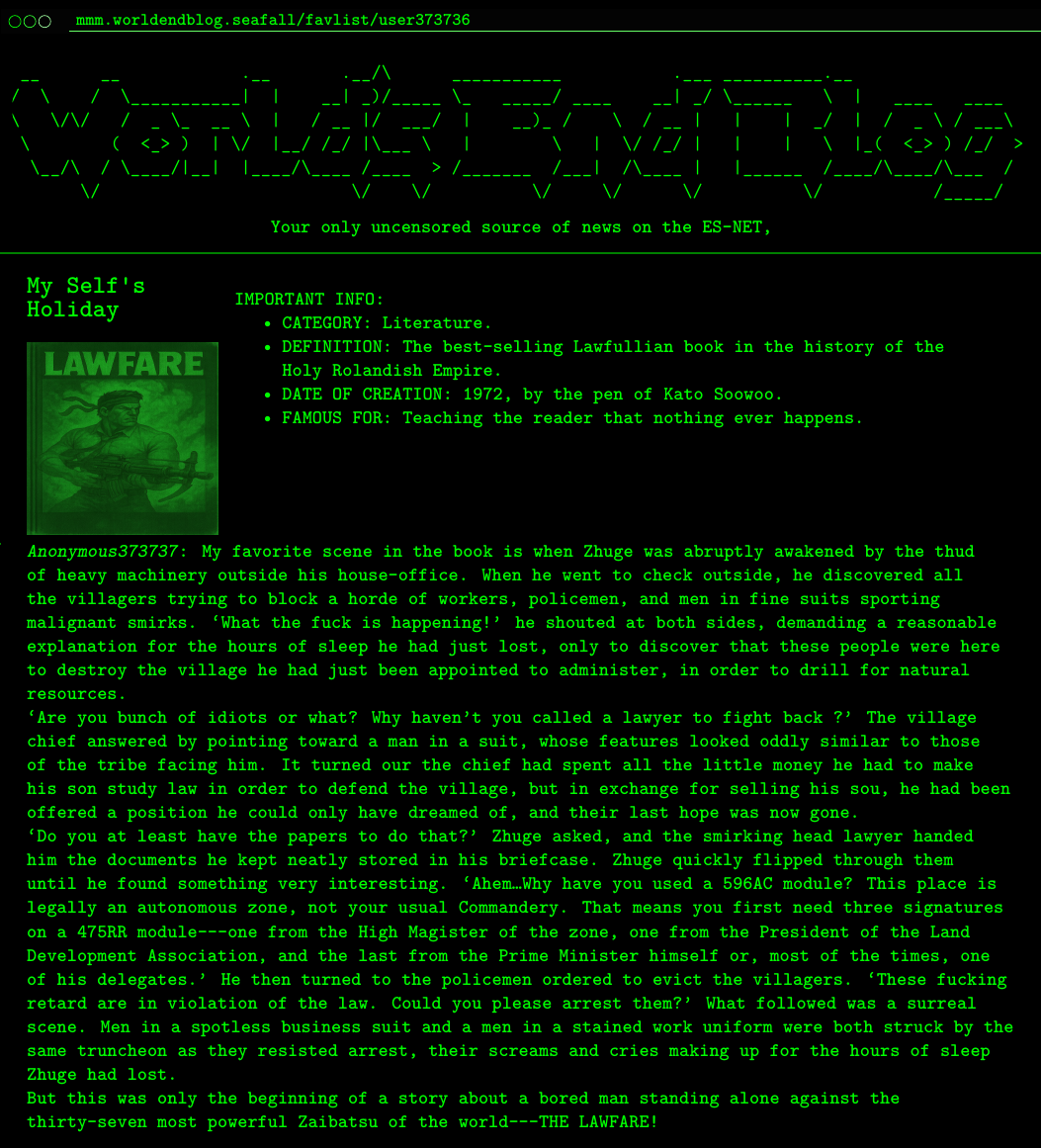
Jacques eagerly nodded, and Hugo’s face brightened as he guided him toward the best-seller section—the third bookcase from the right, seventh shelf from the top. “My Self’s Holiday is a direct translation. The localization team changed the title for the Chaotian edition.” The salesman explained as he retrieved the book.
“What? What’s it called now?” Jacques, who had read the original version in Lawfullian Adamic, couldn’t fathom how anyone who had actually read that book could dare change such a perfect title.
“They made it a little more commercial, and the sales prove it worked—I’ve never seen a foreign book crack the top ten before.” Hugo handed the copy to Jacques. “As you can see, they improved the old cover by removing the boring cherry blossom branch and replacing it with a muscular lawyer wielding a full-automatic Gaussbow with his tie knotted around his forehead like a bandana, and featuring a massive explosion in the background.”
Jacques’ hand trembled as he took the book, and after a few seconds of hesitation, he finally looked at the title—Lawfare. Who could have done this? What sort of monster could take pleasure in defiling an author’s creation? Perhaps… His eyes darted to the back cover. Translated by: Antonio Rodriguez. Cover art by: Diego Pizarro. Published by: Borges Edición; Avenida de la Muerte Mariana, Postal Code 56709… “SUAAAAAREZ!”
Meanwhile, Oshira wandered among the dozens of bookcases that filled the local section of the largest bookstore franchise in the HRE—Bjerregaard & Bundgaard Ltd. To the bronze-skinned lady, the place felt less like a library and more like a mix between a café and an art gallery. The shelves lined only the walls, while most of the floor was occupied by tables where people, under the soothing melodies of a pianist, enjoyed their reading alongside tea and sweets provided by the place. But what struck the ’Copper Blade’ the most was the way the books were arranged with their covers facing the customer, and to the eyes of the Naturian lady, they appeared as a thousand little portraits. Literature had recently become a favored medium for young artists, and so the winners of certain contests were rewarded with the right to have their work proudly exhibited on the books’ covers, hoping some intellectual circle might grant these artists the spark they needed to launch their careers.
The ’Copper Blade,’ bewitched by the splendor of the miniature paintings, opened a book whose cover depicted a dying knight cradled in the arms of his beloved lady. However, her excitement was short-lived because the further she turned the pages, the more the vast majority of words escaped her reach. She moved on to the next book, only to fail again to understand its contents, then another and another, but each time she got the same result. Despite all her best efforts with Sahel, she had made little progress in learning Chaotian Adamic, and her frustration was fully visible across her sorrowful face. Oshira felt as if she were trapped behind the bars of a prison, forced to watch as everyone else flew freely from that library into the thousands of new worlds hidden within its books, leaving her all alone.
Nevertheless, she had been taught since childhood that pain was the fuel of life, and that it could be harnessed to bend reality to her will. So she did not give up, and shelf after shelf, she pressed on, only to be defeated by rich vocabulary, complex grammar, and subtle references beyond her grasp. Yet, her stubbornness made her find a very short book, its pages filled mostly with illustrations and only a few lines of text in the center—something she could understand. It was a simple tale about a powerful crocodile learning that, despite their weakness, lizards were reptiles too, and the story was written with basic words, many of which she already knew due to her studies, while the unfamiliar ones could easily be guessed through the context provided by the colorful drawings that covered every page.
When she reached the final line, her small lips blossomed into a radiant smile, doubling their size as they stretched with both joy and pride. A genuine bream that only grew wider when she noticed that beside her were more books of the same kind—an entire shelf full of stories she could feed to her imagination. For the next hour, the ’Copper Blade’ lost herself page after page, each one carrying her farther from dull reality and deeper into the kaleidoscopic worlds those books were portals to.
“You’ve had a good intuition.” Oshira nearly dropped her book in surprise, her heart skipping a beat as Jacques, who carried a bag with two books of his own, leaned down to retrieve it for her. ”Children’s books to learn Adamic? A good strategy indeed.” She blinked at him in confusion as he browsed the volume. “The Thirty-Six but One Nights, an illustrated anthology of the best short stories from Enoch—your homeland,” he read the title aloud. ”Brilliant idea, Oshira. Since you’ve probably already read them before, it might help you notice the differences between the logics of our languages. Do you want me to read it with you?” The now-blushing girl mumbled something incoherent as Jacques continued flipping through the pages until he stopped at one he recognized. “Oh, I know this one. It was one of my favorite fables as a kid—My Little Black Cat.”
Oshira’s ears pricked up at his words. “…Cat…black…” She rushed to the page, unmistakably recognizing the familiar scene in the dark—a black cat perched on the roof of a magnificent castle, speaking with the prince who leaned out from his bedroom’s window. “CAT BLACK!” Oshira’s amber eyes were now shimmering with excitement.
“I knew you’d know this absolute masterpiece.” Jacques beamed. “So, do you want me to read it, and then we can examine it together—study the sentence structures and the verbs?” The ’Copper Blade’ eagerly nodded, and together with the ’Javelinist,’ she sat at one of the library’s tables, beginning her Adamic lesson.
”Once upon a time, on a busy yet lonely road,
Sat a small black cat with no place to be called home.
Neither a proud Aramashy, nor a strong Shufashy,
just a ragged mongrel, with no family to belong to.
“Ugly! Filthy! Bad!” the orphans would mock,
No one will adopt you, no one will ever love you!”
So with tears in her eyes, she fled far away,
to the streets, where she wandered both night and day.
But the nights were so cold, and in the day her belly so bare,
she mewed to the passersby, but no one would care.
For months she endured the pain, till her strength gave way,
collapsing in her misery, with no hope to cling to.
“They were right, no one loves me at all…”
She despaired, her amber eyes grew heavy.
“You are wrong, my black cat,” a little blue bird said,
perching on her nose and proudly tilting his head.
“Go away! Let me sleep!” the little black cat cried,
but the guest chuckled and twittered at her face.
“Sorry, I can’t let you sleep, not forever, at least,”
he giggled as she growled at him once more.
“Your fur is as dark as the deepest of night,
yet your heart shines with a crystalline light.
And for that alone, I’ll grant you one plea,
go on, little black cat, what’s your dream?”
The cat thought a moment, her eyes full of tears,
choosing a wish she had harbored for so many years.
“To be loved, to belong, to find someone real,
an owner to care for me, someone who’ll adopt me.”
The bird bowed his head, his song ringing sweet,
“Your heart is sincere, your wish I’ll meet.”
And so, on that night, with three moons shining bright,
lit the little black cat as a carriage stopped nearby.”
“Oshira?” Jacques interrupted himself as he felt something rest on his shoulder—the head of a Naturian lady, wearing such a celestial expression that it would have been a crime to disturb her. “Ahem…guess I’ll wait.” And so he did, reading the awful translation of his favorite book with his little black cat sleeping at his side, just as the 'Javelinist' had done a long time ago.
***
“…What is…this?” Oshira asked as her face pressed against the glass of a showcase.
“Bread. It’s called bread,” Jacques replied, pointing at the bakery masterpieces displayed in the shop nestled in the little heaven.
“…Bread not tall…bread not big,” The ’Copper Blade’ argued, mouthwatering at the thought of biting their golden crusts.
The ’Javelinist’ chuckled before explaining. “Well, not being a desert like Enoch really helps with food abundance, and once that’s achieved, people stop searching just for food, but also for creativity. That’s how these greedy pieces of shit can sell the exact same piece of bread at double the price.” The same scene repeated itself at every single showcase.
Once outside the library, Jacques came up with a new idea to help Oshira learn vocabulary, consisting of capitalizing on all the products proudly displayed throughout the island to expand her vocabulary. Boutiques, bakeries, blacksmiths, and more, the couple stopped before each one, and Jacques patiently named every object in the window, and when necessary, he wrote the words down while adding little sketches so Oshira wouldn’t forget them.
After a couple of hours, the plan seemed to have succeeded. Oshira’s vocabulary had grown enough that their conversations became a little smoother than before, and the ’Javelinist’ was proud and delighted with her progress. However, as they walked together down the Boulevard de l’Avenir, Oshira suddenly stopped—her expression darkened as if she was torn by some inner conflict.
“…Jacques,” Oshira mumbled after taking a deep breath, then she retrieved a note from her [Inventory]. “Jacques can…ask a question?” The ’Javelinist’ stopped walking, but did not turn around, and for a few seconds, the girl waited for an answer that never came, so she spoke first. “Do you want to destroy the world?”
Her amber eyes fixed on him as his head slowly turned, and what she saw made her heart freeze. An eerie smirk now spread across his face, but it was his sight that confused her the most, something both magnificent and terrifying. His eyes had changed, now sporting three irises, each glowing with a different hue—one red, one green, and one blue.
Then a miracle happened. 373,736 Antimagic Particles stained the sky crimson, looking as if Adam had been wounded and his blood was now spilling across the heavens. Then, above the ’Javelinist,’ the three moons aligned, forming a symbol Oshira had seen countless times carved upon the temples of Chaotia, and now in the eyes of her classmate.
In the space between the red, blue, and green moons, a blinding light was born, descending to earth and bathing Jacques in a pure white aura that followed him, step by step, as he moved slowly toward the ’Copper Blade.’
“HAIL TO THE MESSIAH!” Oshira turned her head behind to see a crowd of men clad in monk robes, each bearing a slightly different version of the Trinity’s Eye—all three moons depicted in white.
“HAIL TO THE ’HERO!’” From the opposite side, another group emerged, their banners marked with the standard Trinity’s Eye, emblazoned over a black three-headed phoenix.
The two factions clashed in words first, arguing whether the ’World’s End Messiah’ or the ’Hero’ was destined to rule the world. However, compromise turned out to be impossible, and the confrontation quickly devolved into a storm of furious shouting.
*TWANG!* *TWANG!* Suddenly, two shots were heard, and from each side, a monk collapsed to the ground, lifeless. Chaos erupted as both groups accused the other of firing first, and it didn’t take long before some monks stepped forward, armed with a wooden staff, charging headlong into the incoming enemies—the battle began.
Heads were smashed, throats slit, guts spilled—neither side showed the slightest piety for the other. Moreover, by a quick look at their joyful expression, they seemed to relish in the horror show, and even in death, they kept shouting, ’Messiah!’ or ’Hero!,’ laughing as they faced their incoming death. However, no matter how many monks were massacred, more appeared from nowhere—an endless stream of human lives voluntarily joining the slaughterhouse.
Oshira stood frozen as the monks’ blood flooded the road, rising higher and higher until it reached her knees. She could not move a single muscle, only watching as Jacques walked over a row of corpses toward her, each step keeping perfect time with the frantic rhythm of her heartbeat. Then, the ’Javelinist’ leaned in close, his face mere millimeters from hers, and whispered into her ear.
“No.”
The crimson sky, the warring monks, and Jacques’s Trinity’s Eyes all vanished. In an instant, everything returned as it once was, and to Oshira, the memory of the miracle already felt less like reality and more like a fading dream.
“It would be very bad for the economy.”